







Have you ever paused while writing and wondered whether it’s sentence vs sentance? You’re not alone. This is one of the most common spelling confusions in English writing.
The focus keyword sentance vs sentence usually comes up when people are unsure about spelling rules, typing errors, or English grammar basics. The truth is simple: only one of these words is correct in standard English.
In this guide, we’ll break down the difference, explain why the confusion happens, and help you remember the correct form forever.
What is the Correct Spelling: Sentence or Sentance?
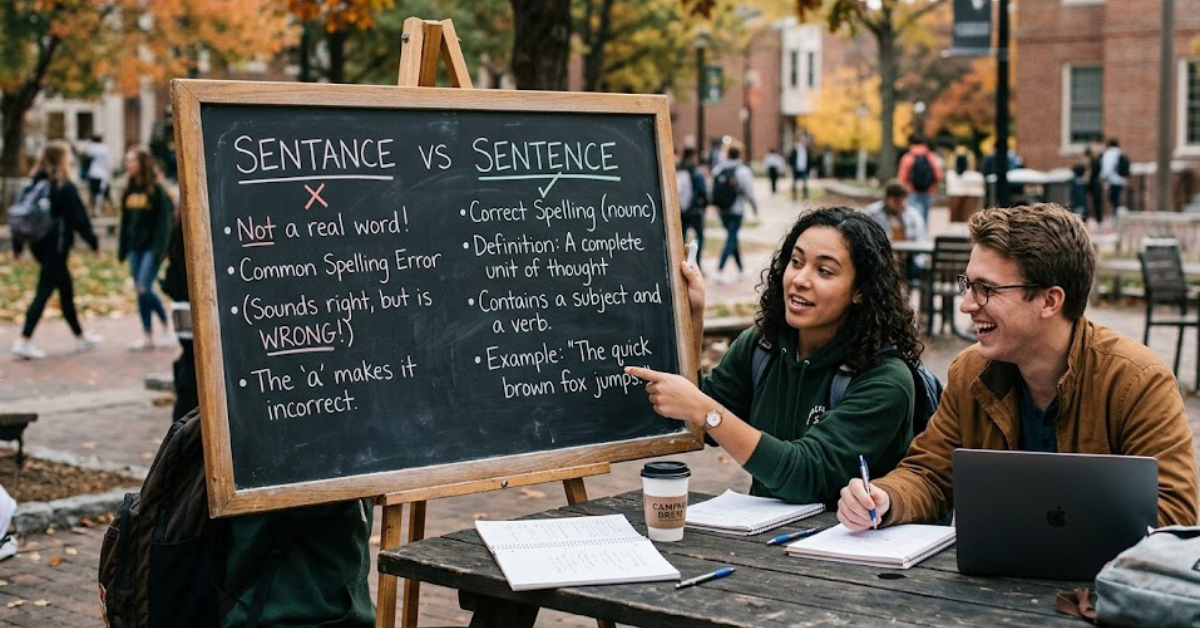
The correct spelling is sentence.
“Sentance” is not a word in standard English. It is simply a common misspelling caused by pronunciation and typing errors.
Quick Fact:
- Sentence = Correct
- Sentance = Incorrect
So when comparing sentance vs sentence, only “sentence” is accepted in grammar, writing, and exams.
Meaning of “Sentence” in English Grammar
A sentence is a group of words that expresses a complete thought. It must have a subject and a verb.
Examples:
- She is reading a book.
- The sun rises in the east.
- I love learning English.
A sentence can be:
- Declarative (statement)
- Interrogative (question)
- Imperative (command)
- Exclamatory (emotion)
Understanding this helps reinforce why “sentence” is such an important grammar term.
Why People Write “Sentance” Instead of “Sentence”
The confusion between sentance vs sentence happens for a few reasons:
1. Pronunciation Influence
The ending “-ence” in sentence sounds like “-ance” to some learners.
2. Typing Errors
Fast typing often leads to accidental misspellings.
3. Similar Word Patterns
English has many words ending in “-ance” like:
- performance
- importance
- distance
So people assume “sentence” follows the same pattern.
Simple Tricks to Remember the Correct Spelling
If you often get confused between sentance vs sentence, here are easy memory tricks:
Think of “Sentence = Sense”
A sentence must make sense.
Break it Down
Sen + tence (not “tance”)
Read and Repeat
Seeing the correct form repeatedly helps train your brain.
Common Uses of the Word “Sentence”
The word “sentence” is used in multiple contexts:
1. Grammar
- Writing correct English sentences
2. Law
- A court sentence (punishment decision)
3. Language Learning
- Building sentences in ESL practice
Each meaning still uses the same spelling: sentence.
Sentance vs Sentence: Key Differences Table
| Feature | Sentence (Correct) | Sentance (Incorrect) |
| Dictionary word | Yes | No |
| Grammar use | Yes | No |
| Academic writing | Accepted | Rejected |
| Meaning | Complete thought | None |
Common Mistakes Related to “Sentence”
People who confuse sentance vs sentence often also make these mistakes:
- Writing “sentense”
- Mixing grammar rules
- Overlooking spelling while focusing on speed
- Using autocorrect without checking
Careful proofreading solves most of these issues.
FAQs: Sentance vs Sentence
1. Is “sentance” a real word?
No, “sentance” is not a real English word. It is a misspelling of “sentence.”
2. Why do people write sentance instead of sentence?
It usually happens due to pronunciation confusion and spelling habits from similar words.
3. What is the correct spelling: sentance or sentence?
The correct spelling is sentence.
4. Does “sentence” have different meanings?
Yes, it can refer to grammar structure or a legal punishment decision.
5. How can I avoid spelling sentence wrong?
Practice writing it often, break it into parts (“sen-tence”), and read more English content.
Conclusion: Sentance vs Sentence Made Simple
When it comes to sentance vs sentence, the answer is clear: only “sentence” is correct. “Sentance” is just a common spelling mistake that appears in informal writing.
By understanding the meaning, usage, and memory tricks shared above, you can confidently avoid this error in the future. Strong spelling not only improves your writing but also makes your communication clearer and more professional.
If you want to improve your English further, keep practicing sentence formation and pay attention to commonly confused words like this one.