

Have you ever heard someone say “Mazel Tov!” at a wedding or celebration and wondered what the word mazal actually means? While many people associate it with congratulations, the word itself has a much deeper cultural and historical meaning.
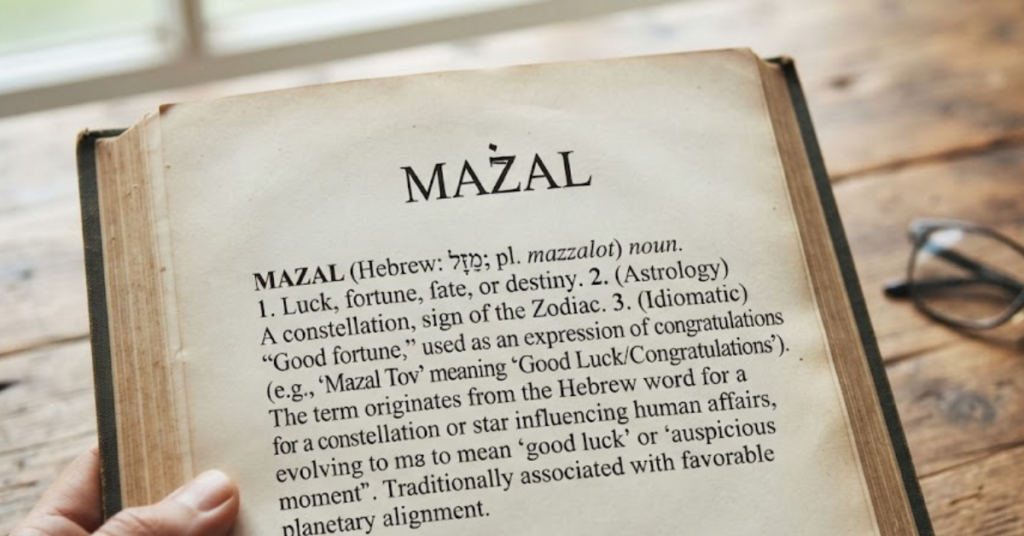
If you’re searching for the mazal meaning, you’ve come to the right place. In Hebrew, mazal (מַזָּל) traditionally refers to luck, fortune, destiny, or good fortune. Over centuries, the term has become an important part of Jewish culture and has influenced expressions used around the world. In this guide, you’ll learn what mazal means, its origin, how it’s used in English, what “Mazel Tov” really means, and even the meaning behind the lesser-known term mazalito.
What Is the Mazal Meaning?
The simplest definition is:
Mazal means luck, fortune, destiny, or favorable circumstances.
Although it’s commonly translated as “luck,” the Hebrew word carries a richer meaning than simple chance. It often refers to a person’s destiny, blessings, or favorable fortune in life.
In everyday conversation, mazal may describe someone who is fortunate or experiences positive outcomes.
Examples:
- She has good mazal in business.
- Many believe hard work and mazal together lead to success.
- People wished the newlyweds happiness and good mazal.
Define Mazal: More Than Just Luck
If you want to define mazal, it’s helpful to understand its broader cultural significance.
Historically, the word has been associated with:
- Fortune
- Good luck
- Destiny
- Blessings
- Favorable timing
- Prosperity
Unlike the English word “luck,” which often suggests randomness, mazal can imply that positive events occur through divine blessing, destiny, or favorable circumstances.
Mazal Meaning in English
The most common mazal meaning in English includes:
- Luck
- Fortune
- Good fortune
- Destiny
- Blessing
- Favorable fate
No single English word captures the full depth of the Hebrew term, which is why translators often choose different equivalents depending on the context.
For example:
Hebrew
“He has mazal.”
Possible English translations:
- He’s lucky.
- He’s fortunate.
- Good fortune follows him.
- He seems blessed.
Each translation captures part of the original meaning.
The Origin of the Word Mazal
The word mazal comes from Hebrew and appears in ancient Jewish texts.
Originally, it referred to:
- Constellations
- Zodiac signs
- Celestial influences
In early Jewish tradition, the movement of stars and heavenly bodies was sometimes connected to a person’s destiny or fortune. Over time, the meaning evolved into the more familiar concepts of luck and good fortune.
Today, the astronomical meaning is less common than its everyday use.
Mazal in Jewish Culture
Mazal plays an important role in Jewish traditions and celebrations.
People often use it during:
- Weddings
- Births
- Bar and Bat Mitzvahs
- Graduations
- Career achievements
- Major life milestones
Rather than focusing only on luck, the word expresses joy and hopes for continued success.
The Famous Expression: Mazel Tov
Perhaps the best-known phrase containing mazal is:
Mazel Tov
Contrary to what many people believe, Mazel Tov does not literally mean “good luck.”
Instead, it means something closer to:
- Congratulations
- Congratulations on your success
- Good fortune has come to you
For example:
- Your baby was born? Mazel Tov!
- You got married? Mazel Tov!
- You graduated? Mazel Tov!
It’s used after a happy event has happened—not before it.
Is Mazal the Same as Luck?
Not exactly.
Although many dictionaries translate mazal as “luck,” native Hebrew speakers often understand it as something broader.
Think of it this way:
| Luck | Mazal |
| Random chance | Fortune mixed with destiny or blessing |
| Temporary | Often viewed as ongoing fortune |
| Pure coincidence | May imply divine favor or favorable destiny |
This distinction gives the word a richer emotional and cultural meaning.
Everyday Examples of Mazal
Here are a few examples showing how the word is used.
Example 1
“He always seems to have mazal when investing.”
Meaning:
He has consistently good fortune.
Example 2
“The family wished them health, happiness, and mazal.”
Meaning:
They wished them a fortunate and blessed life.
Example 3
“Mazel Tov on your promotion!”
Meaning:
Congratulations on your achievement.
What Does Mazal Mean Spiritually?
In spiritual discussions, mazal can represent:
- Divine blessing
- Favor
- Positive destiny
- Life’s fortunate path
- Heavenly influence
Some Jewish teachings emphasize that while mazal influences life, personal choices, prayer, and good deeds also shape one’s future.
This makes the concept more nuanced than simple luck.
Mazal in Modern Hebrew
In Israel today, the word remains part of everyday speech.
You’ll hear it in expressions like:
- Good mazal
- Bad mazal
- Mazel Tov
Modern speakers often use it naturally in conversations about success, opportunities, or fortunate events.
What Is Mazalito Meaning?
A growing number of people search for mazalito meaning, but it’s important to understand that Mazalito is not a standard Hebrew word.
Instead, it usually appears as:
- A nickname
- A pet name
- A term of affection
- A social media username
- A creative variation of “mazal”
The ending “-ito” comes from Spanish, where it commonly expresses affection or smallness.
For example:
- Perro → Perrito (little dog)
- Gato → Gatito (little cat)
Because of this, “mazalito” may be used informally to mean something like:
- Little lucky one
- Dear fortunate one
- A cute variation of mazal
However, it is not an official Hebrew dictionary term.
Common Misunderstandings About Mazal
Several misconceptions surround the word.
Mistake 1: Thinking It Means Only Luck
While luck is part of its meaning, mazal also includes ideas of destiny, fortune, and blessing.
Mistake 2: Using Mazel Tov Before an Event
Many English speakers mistakenly use “Mazel Tov” to wish someone good luck.
In reality, it’s traditionally said after something positive has happened.
Mistake 3: Assuming Mazalito Is Traditional Hebrew
Although people search for it online, mazalito is generally an informal or creative adaptation rather than a traditional Hebrew word.
Related Hebrew Words
Understanding a few related terms makes mazal easier to appreciate.
- Mazel Tov – Congratulations
- Shalom – Peace
- Todah – Thank you
- Chai – Life
- Simcha – Joy or celebration
These words frequently appear in Jewish culture and celebrations.
Practical Tips for Using Mazal Correctly
If you want to use the word naturally:
- Use mazal when discussing fortune or blessings.
- Say Mazel Tov after someone’s achievement.
- Don’t use “Mazel Tov” to wish someone luck before an exam or competition.
- Remember that the word carries cultural significance beyond its dictionary definition.
Key Takeaways
- Mazal means luck, fortune, destiny, or blessing.
- The word comes from Hebrew and has ancient origins.
- Mazel Tov means “Congratulations,” not “Good luck.”
- Mazal represents more than random chance—it often suggests favorable destiny or divine blessing.
- Mazalito is generally an informal nickname rather than a traditional Hebrew word.
Frequently Asked Questions
What does mazal mean?
Mazal is a Hebrew word meaning luck, fortune, destiny, or favorable circumstances. Its exact meaning depends on the context in which it is used.
What is the mazal meaning in English?
In English, mazal is commonly translated as luck, fortune, or good fortune. However, the original Hebrew meaning also includes ideas of destiny and blessing.
Define mazal in simple words.
Mazal refers to positive fortune or favorable destiny. It’s often used to describe someone who experiences good things in life.
Is Mazel Tov the same as good luck?
No. Mazel Tov means Congratulations and is traditionally said after a happy event has already occurred rather than before it.
What does mazalito mean?
Mazalito is generally an informal or affectionate variation of “mazal,” influenced by the Spanish diminutive “-ito.” It is not considered a standard Hebrew dictionary word.
Is mazal a religious word?
Mazal has religious and cultural roots in Judaism, but today it is also widely used in everyday conversations about fortune, blessings, and celebrations.
Conclusion
Understanding the mazal meaning goes beyond simply translating it as “luck.” Rooted in Hebrew language and Jewish tradition, mazal represents fortune, destiny, blessings, and favorable circumstances that shape life’s positive moments. Its rich cultural history explains why it remains such an important part of expressions like Mazel Tov, which celebrates success and joyful milestones.
Whether you were curious about what does mazal mean, wanted to define mazal, or were exploring the mazal meaning in English, you now have a clearer understanding of its origins and everyday usage. As with many meaningful words, appreciating its cultural context helps you use it more accurately and respectfully in conversation.