
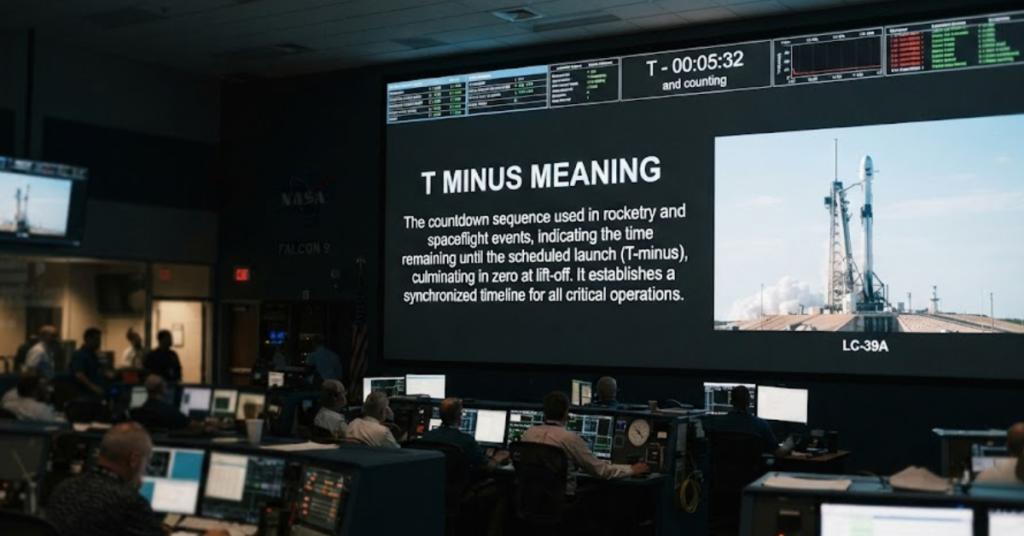

Have you ever heard someone say, “T-minus 10 minutes until the meeting starts” or watched a rocket launch where the announcer counts down, “T-minus 30 seconds”? If you’ve wondered what that phrase actually means, you’re not alone.
The T minus meaning is surprisingly simple once you understand its origin. The term comes from the world of spaceflight and refers to the amount of time remaining before a scheduled event takes place. Today, however, it’s used far beyond rocket launches—in workplaces, sports, military operations, entertainment, and even casual conversations. In this guide, you’ll learn what does T-minus mean, where it came from, how it’s used, and why it has become part of everyday language.
What Does T-Minus Mean?
The simplest definition is:
T-minus means the amount of time remaining before a planned event begins.
The “T” stands for time, while “minus” indicates that the countdown is moving toward zero.
For example:
- T-minus 30 minutes = 30 minutes until the event starts.
- T-minus 5 days = Five days remaining.
- T-minus 10 seconds = Ten seconds before launch or another scheduled event.
When the countdown reaches T-0 (T-zero), the event officially begins.
The Origin of T-Minus
The phrase originated in the aerospace industry.
During rocket launches, engineers needed a standardized countdown system that everyone involved could understand. Instead of saying, “Thirty seconds before launch,” they adopted the simpler format:
T-minus 30 seconds.
The countdown continues until:
- T-minus 10
- T-minus 5
- T-minus 1
- T-zero
At T-zero, ignition or liftoff occurs.
This terminology became famous through televised space missions, especially during the early days of space exploration.
Why Is It Called T-Minus?
The phrase has two parts:
T = Time
The letter T represents the scheduled event time.
It doesn’t necessarily refer to a clock. Instead, it’s the reference point for the event.
Minus = Before the Event
The word minus simply means you’re counting backward from the event.
For example:
- T-minus 60 minutes
- T-minus 15 minutes
- T-minus 1 minute
After the event begins, some systems use T-plus to measure time afterward.
Example:
- T-plus 10 minutes
- T-plus 2 hours
T Minus Meaning in Everyday Life
Although it began with rockets, the phrase now appears almost everywhere.
People commonly use T minus before:
- Meetings
- Exams
- Product launches
- Weddings
- Sporting events
- Flights
- School events
- Deadlines
For example:
We’re at T-minus two hours until the conference starts.
Meaning:
There are two hours remaining.
Examples of T-Minus in Sentences
Here are some real-world examples.
Workplace
T-minus 15 minutes until the presentation begins.
School
We’re at T-minus one week before final exams.
Sports
T-minus 30 minutes until kickoff.
Travel
T-minus three hours before boarding.
Everyday Conversation
T-minus five days until vacation!
T-Minus vs Countdown
Although the two ideas are related, they aren’t exactly the same.
| Term | Meaning |
| T-minus | Time remaining before a scheduled event |
| Countdown | Any backward count toward an event |
For example:
A countdown might be:
10…9…8…7…
Meanwhile:
T-minus 10 seconds refers to the amount of time left before that countdown reaches zero.
What Is T-Zero?
One important part of understanding T-minus meaning is knowing about T-zero.
T-zero marks the exact moment when the planned event happens.
Examples include:
- A rocket lifts off.
- A presentation officially begins.
- A race starts.
- A product launches.
Everything before that moment is measured using T-minus.
What Is T-Plus?
After the event starts, many industries switch to T-plus.
For example:
- T-plus 30 seconds
- T-plus 5 minutes
- T-plus 2 hours
This simply indicates how much time has passed since the event began.
Space agencies frequently use both T-minus and T-plus during missions.
Where You’ll Hear T-Minus Today
Although rooted in aerospace, the phrase now appears in many settings.
Common examples include:
- Television broadcasts
- Live events
- Product launches
- Video games
- Military operations
- NASA documentaries
- Business meetings
- Social media posts
Because it’s widely understood, many people use it humorously in everyday conversations.
Why Has T-Minus Become So Popular?
There are several reasons.
It:
- Creates excitement.
- Builds anticipation.
- Clearly communicates remaining time.
- Sounds concise and professional.
- Is instantly recognizable because of space missions.
That’s why marketers, event organizers, and even friends planning parties often use it.
Common Mistakes About T-Minus
Mistake 1: Thinking It Only Applies to Rockets
Not true.
Although it originated in spaceflight, the phrase now applies to almost any scheduled event.
Mistake 2: Assuming T Means “Timer”
The “T” stands for time, not timer.
Mistake 3: Using T-Minus After the Event
Once the event has started, T-plus is usually the more accurate expression.
Practical Tips for Using T-Minus
If you want to sound natural:
Use T-minus when:
- Building excitement
- Announcing upcoming events
- Managing schedules
- Giving countdown updates
Examples:
- T-minus one hour until kickoff.
- T-minus two days before launch.
- T-minus five minutes until we begin.
These expressions sound clear, energetic, and widely understood.
Key Takeaways
- The T minus meaning refers to the time remaining before an event.
- The “T” stands for time.
- The phrase originated in rocket launch countdowns.
- T-zero marks the exact start of the event.
- After the event begins, many people use T-plus instead.
- Today, T-minus is common in business, sports, education, travel, and everyday conversation.
Frequently Asked Questions
What does T-minus mean?
T-minus means the amount of time remaining before a planned event begins. It’s commonly used in countdowns for launches, meetings, games, and other scheduled activities.
What does T-minus mean in space launches?
In aerospace, T-minus refers to the countdown leading up to liftoff. When the countdown reaches T-zero, the rocket launches.
Why do people say T-minus?
People use the phrase because it’s a concise and exciting way to announce how much time remains before something happens. It has become popular well beyond its aerospace origins.
What is the difference between T-minus and T-plus?
T-minus measures the time before an event, while T-plus measures the time after the event has started.
Can T-minus be used in everyday conversation?
Yes. Many people use it informally to refer to the time remaining before meetings, vacations, birthdays, deadlines, or other important occasions.
Does T-minus always involve seconds?
No. T-minus can refer to seconds, minutes, hours, days, weeks, or even months, depending on the event being discussed.
Conclusion
Understanding the T minus meaning is easier once you know its roots in space exploration. Originally developed for rocket launch countdowns, the phrase simply refers to the amount of time remaining before a scheduled event. Whether someone says T-minus 10 seconds, T-minus one hour, or T-minus five days, they’re counting down to a specific moment.
Today, T-minus has become a versatile expression used in workplaces, schools, sporting events, entertainment, and everyday conversations. Knowing what does T-minus mean not only helps you understand countdowns more clearly but also adds a familiar and engaging phrase to your own vocabulary. The next time you hear it, you’ll know exactly what it means—and how close the big moment really is.