






Have you ever started an email and paused to wonder whether “dear all” is the right greeting? It’s one of the most common salutations used in workplaces, schools, organizations, and community groups, yet many people remain unsure about when and how to use it correctly.
In this guide, we’ll explore the meaning of dear all, proper email etiquette, examples, alternatives, and even common phrases such as “dear all or dear all” and “dear all trick or treaters.” Whether you’re writing a professional email or a group announcement, understanding this greeting can help you communicate more effectively.
What Does “Dear All” Mean?
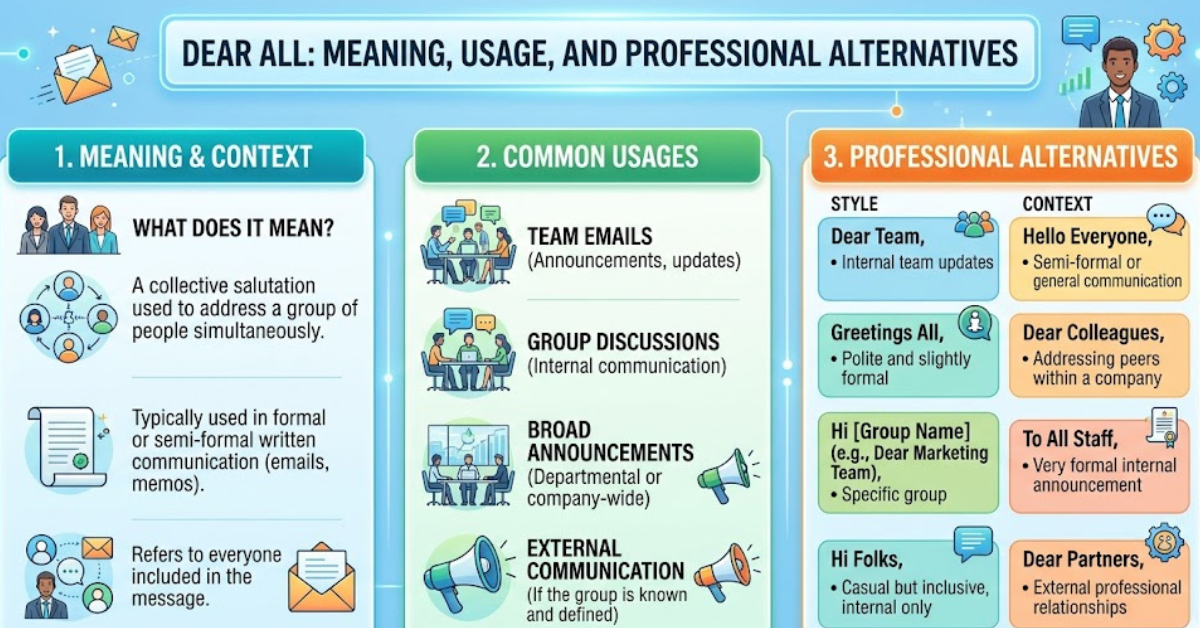
Dear all is a collective greeting used when addressing multiple recipients at the same time. Instead of listing every individual’s name, the sender uses a single salutation to acknowledge everyone included in the message.
For example:
Dear All,
I hope you are doing well. I would like to share an important update regarding next week’s meeting.
The phrase is widely accepted in business communication, educational settings, volunteer organizations, and community groups.
Key Characteristics of “Dear All”
- Addresses multiple people simultaneously.
- Saves time when emailing large groups.
- Maintains a polite and professional tone.
- Works well when recipients have equal status.
Is “Dear All” Professional?
Yes, dear all is generally considered professional and appropriate for group emails. Many organizations use it regularly when communicating with teams, departments, or project groups.
However, context matters.
When “Dear All” Is Appropriate
Use dear all when:
- Sending information to a team.
- Addressing an entire department.
- Contacting committee members.
- Writing to classmates or study groups.
- Sending organizational announcements.
When It May Not Be Ideal
Avoid using dear all when:
- Writing to a single recipient.
- Contacting senior executives individually.
- Sending highly personalized messages.
- Communicating with clients who expect a more tailored greeting.
In those situations, using names often creates a stronger connection.
Dear All or Dear All: Understanding the Confusion
One commonly searched phrase is “dear all or dear all.”
The confusion often comes from people wondering whether there is an alternative spelling, capitalization, or punctuation rule.
The correct form is simply:
Dear All,
or
Dear all,
Both capitalization styles are acceptable depending on company formatting guidelines.
Common Email Format
Dear All,

Thank you for attending yesterday's meeting.

Best regards,
Your Name
Most style guides focus more on consistency than strict capitalization rules.
Why “Dear All” Remains Popular in Business Communication
The popularity of dear all comes from its simplicity and efficiency.
Benefits of Using Dear All
1. Saves Time
Instead of writing multiple names, one greeting addresses everyone.
2. Creates Inclusivity
Every recipient feels acknowledged equally.
3. Works Across Different Groups
Whether you’re emailing five colleagues or fifty volunteers, the greeting remains effective.
4. Professional Yet Friendly
It strikes a balance between formal and approachable communication.
Alternatives to “Dear All”
While dear all is useful, there are times when another greeting may work better.
Professional Alternatives
- Hello Everyone
- Greetings Team
- Good Morning Team
- Hi Everyone
- Dear Colleagues
- Dears Team
- Hello All
- Good Afternoon Everyone
Formal Alternatives
- Dears Members
- Dears Participants
- Dears Stakeholders
- Dears Committee Members
Casual Alternatives
- Hi All
- Hello Everyone
- Hi Team
The best choice depends on your audience and organizational culture.
Examples of Dears All in Different Situations
Team Update
Dears All,
Please review the attached project timeline before Friday’s meeting.
Thank you.
School Announcement
Dears All,
The examination schedule has been published on the student portal.
Best wishes.
Volunteer Group Communication
Dears All,
Thank you for your support during the community event. Your contributions made a significant difference.
Dears All Trick or Treaters: Meaning and Usage
The phrase “dears all trick or treaters” may appear in seasonal announcements, Halloween event invitations, or community notices.
For example:
Dear All Trick or Treaters,
Please remember that Halloween activities will begin at 6:00 PM and conclude at 9:00 PM.
In this context, the greeting addresses everyone participating in trick-or-treat activities.
Example Halloween Message
Dears All Trick or Treaters,
We are excited to welcome you this Halloween. Please follow safety guidelines, stay with your group, and enjoy the festivities responsibly.
Happy Halloween!
Common Mistakes When Using Dears All
Even though the phrase is simple, some mistakes can reduce professionalism.
Mistake 1: Using It for One Person
Incorrect:
Dear All,
when emailing a single recipient.
Mistake 2: Overusing It
Frequent use can make communication feel impersonal. Personalize messages when appropriate.
Mistake 3: Forgetting Context
Different audiences may prefer:
- Dears Team
- Hello Everyone
- Dears Members
Choose the greeting that best matches the group.
Best Practices for Writing Group Emails
When using dear all, follow these communication tips:
Keep the Message Clear
Use concise language and organize information logically.
Use Bullet Points
For important updates:
- Meeting date changed to Friday.
- Submit reports by Wednesday.
- Review attached documents.
Maintain Professional Tone
Even when communicating with familiar colleagues, remain respectful and courteous.
Include a Strong Closing
Examples:
- Kind regards
- Best regards
- Thank you
- Sincerely
How Dear All Compares to Other Greetings
| Greeting | Formality | Best Use |
| Dears All | Professional | Group emails |
| Hi All | Casual | Internal teams |
| Hello Everyone | Friendly | Mixed audiences |
| Dears Team | Professional | Work teams |
| Dears Colleagues | Formal | Corporate communication |
The Future of Group Email Greetings
As workplace communication evolves, greetings continue to become more conversational. While newer options like “Hello Everyone” and “Hi Team” are gaining popularity, dears all remains a respected and widely accepted choice in professional settings.
Its simplicity, inclusiveness, and versatility ensure that it will likely remain a standard greeting for years to come.
FAQs About Dears All
Is “Dears All” grammatically correct?
Yes. Dears all is grammatically correct and commonly used when addressing multiple recipients in an email or letter.
Is “Dear All” too formal?
Not necessarily. It sits comfortably between formal and informal communication, making it suitable for many workplace situations.
What is better than “Dears All”?
Alternatives include:
- Hello Everyone
- Dears Team
- Hi All
- Dears Colleagues
The best choice depends on your audience.
Should I capitalize “All” in Dear All?
Both Dear All and all are acceptable. Follow your organization’s preferred style.
Can I use Dears All in a business email?
Yes. It is widely accepted in professional communication when addressing groups.
What does “Dear All Trick or Treaters” mean?
It is a seasonal greeting used to address a group of people participating in Halloween trick-or-treat activities.
Conclusion
The phrase dear all remains one of the most useful and professional greetings for group communication. It offers a respectful, inclusive, and efficient way to address multiple recipients without listing individual names. Understanding when to use dear all, recognizing suitable alternatives, and avoiding common mistakes can help improve the clarity and professionalism of your emails.
Whether you’re writing workplace announcements, educational updates, community messages, or even seasonal notes to dear all trick or treaters, choosing the right greeting sets the tone for effective communication. For even stronger communication skills, explore related guides on email etiquette, business writing, and professional correspondence.