







Imagine a country deciding to shut its doors to international trade and rely almost entirely on its own resources. This economic system, known as a closed economy, requires significant government intervention to limit interactions with foreign markets. A common question people ask is: what restriction would the government impose in a closed economy?
The simple answer is that the government would impose restrictions on international trade, such as banning or heavily limiting imports and exports, controlling foreign investments, and implementing strict economic regulations. These measures are designed to keep the nation’s economy self-contained.
In this article, we will explore the main restrictions found in a closed economy, why governments implement them, and their potential advantages and disadvantages.
Understanding the Meaning of a Closed Economy
A closed economy is an economic system where a country does not engage in significant trade or financial transactions with other nations. Unlike an open economy, which allows the free movement of goods, services, and capital across borders, a closed economy focuses on domestic production and consumption.
In a truly closed economy, the government controls economic activities to reduce dependence on foreign countries.
Key Characteristics of a Closed Economy
Some of the main features include:
- Little or no international trade
- Government control over imports and exports
- Limited foreign investment
- Dependence on domestic industries and resources
- Strict regulations on foreign exchange
These characteristics explain why government restrictions are necessary for maintaining a closed economic system.
What Restriction Would the Government Impose in a Closed Economy?
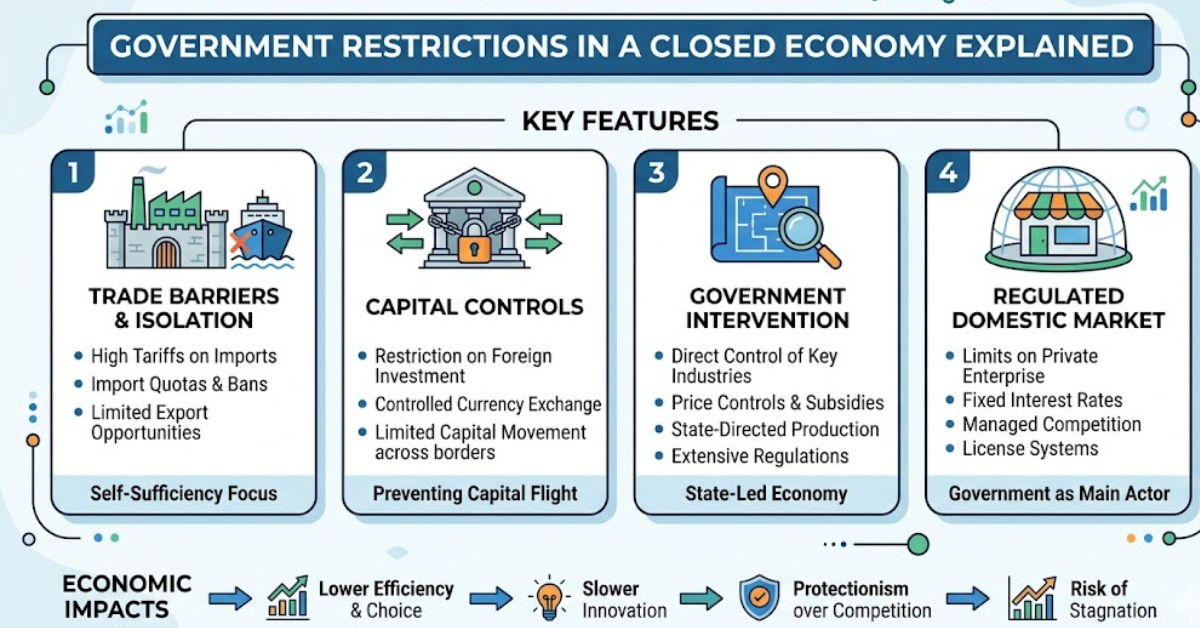
The primary restriction a government would impose in a closed economy is limiting or prohibiting international trade. This means businesses and individuals cannot freely buy goods from foreign countries or sell their products abroad.
Several specific restrictions may be used to enforce a closed economy.
1. Import Restrictions and Import Bans
One of the most important policies in a closed economy is limiting imports. The government may:
- Ban certain foreign products
- Set strict quotas on imported goods
- Require special licenses for imports
- Impose high tariffs to discourage foreign purchases
These restrictions are intended to protect domestic industries from international competition.
2. Export Controls
A government may also regulate or restrict exports to ensure that important goods and resources remain available within the country.
Examples include restrictions on:
- Food supplies during shortages
- Natural resources
- Strategic materials
- Essential manufactured goods
Export controls help the country prioritize domestic needs over foreign demand.
3. Restrictions on Foreign Investment
In a closed economy, governments often limit the ability of foreign companies or investors to own businesses or assets within the country. This can include:
- Prohibiting foreign ownership of certain industries
- Requiring government approval for foreign investments
- Limiting the amount of money that can enter or leave the country
These measures allow the government to maintain greater control over the national economy.
4. Currency and Foreign Exchange Controls
Since a closed economy aims to reduce international financial interaction, governments may control the exchange of domestic currency for foreign currencies.
Common restrictions include:
- Limits on holding foreign currency
- Government approval for international payments
- Restrictions on transferring money abroad
Currency controls help prevent excessive capital outflow and maintain economic stability.
5. Government Regulation of Domestic Production
A closed economy may involve stronger government oversight of local industries. The government may:
- Set production targets
- Control prices of essential goods
- Provide subsidies to domestic businesses
- Regulate the distribution of resources
The goal is to ensure that the country can meet its own economic needs without relying on other nations.
Why Would a Government Choose a Closed Economy?
Although most modern nations participate in global trade, some governments may adopt elements of a closed economy for specific reasons.
Common Reasons Include:
- Protecting local industries from foreign competition
- Achieving economic self-sufficiency
- Preserving national security by controlling strategic resources
- Reducing dependence on foreign markets
- Managing economic crises or sanctions
However, complete economic isolation is rare in today’s interconnected world.
Advantages of Government Restrictions in a Closed Economy
Supporters argue that a closed economy can offer several benefits, such as:
- Protection for new or developing industries
- Greater control over national resources
- Reduced vulnerability to international economic shocks
- Increased domestic employment in certain sectors
For some countries, temporary trade restrictions can help industries grow before competing globally.
Disadvantages of a Closed Economy
Despite some benefits, strict economic restrictions can create challenges, including:
- Higher prices due to limited competition
- Fewer choices for consumers
- Reduced access to advanced technology
- Slower innovation
- Lower efficiency among domestic businesses
Many economists believe that a balanced approach involving both domestic protection and international trade often produces better long-term results.
Closed Economy vs Open Economy
The difference between a closed and open economy is mainly the level of government control over international transactions.
| Closed Economy | Open Economy |
| Restricts imports and exports | Encourages international trade |
| Limits foreign investment | Allows global investments |
| Relies mainly on domestic production | Uses both domestic and foreign resources |
| Has stronger government economic control | Has more market freedom |
Frequently Asked Questions (FAQs)
1. What restriction would the government impose in a closed economy?
The government would primarily impose restrictions on international trade, including import bans, export controls, foreign investment limits, and foreign exchange restrictions.
2. Why does a closed economy restrict imports?
Imports are restricted to protect domestic industries, promote local production, and reduce dependence on foreign countries.
3. Do closed economies allow foreign investment?
Most closed economies heavily limit or strictly regulate foreign investment to maintain national control over economic activities.
4. Is a completely closed economy possible today?
A completely closed economy is extremely rare in the modern world because most countries depend on global trade for resources, technology, and economic growth.
5. What is the biggest disadvantage of a closed economy?
One major disadvantage is reduced competition, which can lead to higher prices, lower quality products, and slower innovation.
Conclusion
So, what restriction would the government impose in a closed economy? The most important restriction would be limiting or preventing international trade through import controls, export regulations, foreign investment restrictions, and currency controls.
While these policies can protect domestic industries and increase government control over the economy, they may also limit consumer choices and slow economic progress. Understanding how closed economies work helps explain the balance that modern nations must strike between economic independence and participation in the global marketplace.
To learn more about economic systems, consider exploring related topics such as open economies, trade barriers, tariffs, and government economic policies.