





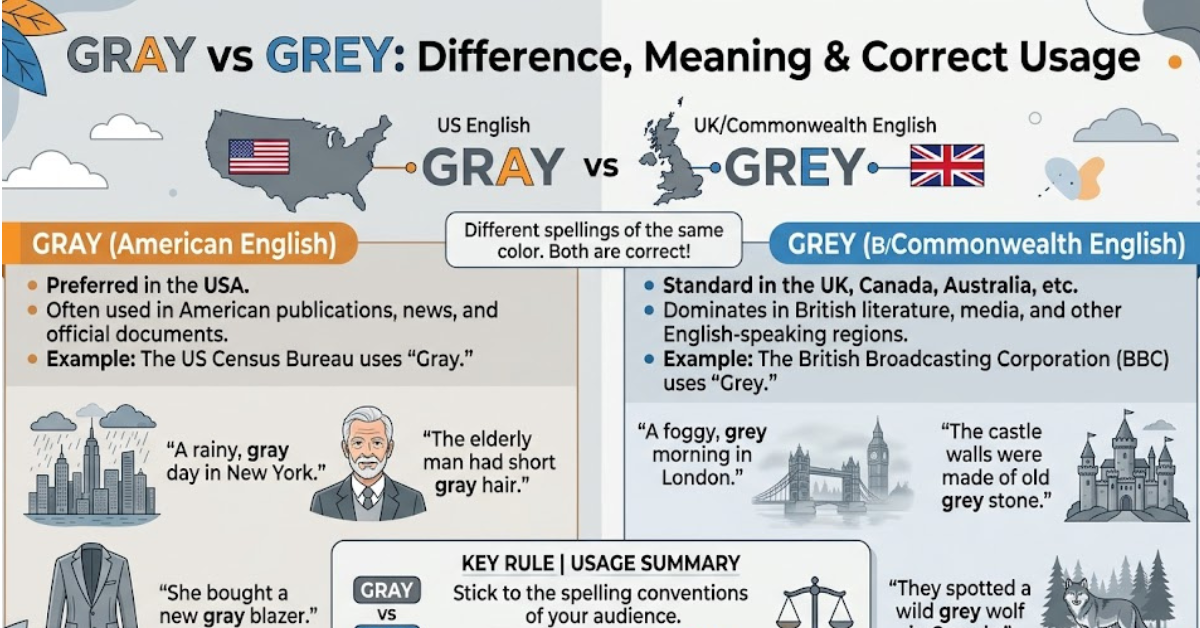
Have you ever stopped while writing and wondered, “whats the difference between gray and grey?” You’re not alone. These two spellings often create confusion because they refer to the same color but are used differently depending on location and language conventions.
The good news is that there is no difference in meaning between gray and grey. Both describe the neutral color between black and white. The main distinction lies in regional spelling preferences, with “gray” being more common in American English and “grey” being preferred in British English and many other English-speaking countries.
In this guide, we’ll explore the difference between gray vs grey, their history, proper usage, and examples to help you choose the correct spelling with confidence.
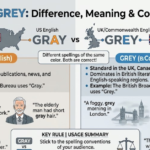
Gray vs Grey: What Is the Difference?
The simple answer to whats the difference between gray and grey is geography.
- Gray is the preferred spelling in the United States.
- Grey is the preferred spelling in the United Kingdom, Canada, Australia, and other countries that follow British English conventions.
For example:
- American English: The sky turned gray before the storm.
- British English: The sky turned grey before the storm.
Both sentences are correct; the only difference is the regional style of English.
Do Gray and Grey Have Different Meanings?
No, gray and grey have exactly the same meaning. They both describe a color that falls between black and white on the color spectrum.
The words can also be used metaphorically to describe things that are uncertain, unclear, or lacking clear boundaries. For example:
- A gray/grey area refers to a situation where rules or answers are not completely clear.
- Gray/grey mood can describe a feeling of sadness or dullness.
- Gray/grey hair refers to hair that has lost its natural pigment with age.
The meaning remains unchanged regardless of the spelling.
The History Behind Gray and Grey
The word originates from the Old English term “grǣg,” which was used to describe the color. Over time, English developed different spelling traditions, leading to the modern forms “gray” and “grey.”
When American English became more standardized in the 18th and 19th centuries, writers such as Noah Webster promoted simplified spellings. As a result, gray became the dominant spelling in the United States, while grey remained standard in British English.
How to Remember Which Spelling to Use
If you often forget whether to use gray or grey, these simple memory tricks can help:
For American English
Remember:
A in grAy = America
If you are writing for an American audience, “gray” is usually the best choice.
For British English
Remember:
E in grEy = England
If your audience follows British English, use “grey.”
Gray vs Grey in Different Contexts
Writing and Academic Use
The most important rule is consistency. If you are writing a paper, article, or professional document, stick to one spelling based on the style guide you are following.
For example:
- APA style generally uses gray because it follows American English.
- British publications usually prefer grey.
Brand Names and Proper Nouns
Some companies and names choose a specific spelling regardless of location. For example:
- Grey Goose (the vodka brand) uses “grey.”
- A person with the surname Gray or Grey uses whichever spelling belongs to their name.
Always preserve the official spelling of names and brands.
Technology and Design
In graphic design, web development, and software, you may see both spellings. Some systems use “gray” in coding terms, such as gray scale or gray colors, while designers in British regions may write “greyscale.”
Is Gray or Grey More Popular?
Globally, grey is more commonly used because many countries follow British English conventions. However, gray dominates in the United States.
Neither spelling is more correct than the other. The best choice depends on your audience and the English variation you are using.
Common Mistakes to Avoid
When deciding between gray and grey, avoid these common errors:
- Mixing both spellings in the same document unless there is a specific reason.
- Assuming one spelling is incorrect, because both are accepted.
- Changing official names or brand spellings to match your preferred style.
Consistency is the key to professional writing.
FAQs
Is gray and grey the same color?
Yes. Gray and grey represent the same color between black and white. The only difference is the spelling.
Which is correct: gray or grey?
Both are correct. Use gray for American English and grey for British English and other regions that follow British spelling.
Why do Americans spell it gray?
American English adopted “gray” as the standard spelling during the development of American dictionaries and spelling conventions, especially through the influence of Noah Webster.
Why do British people write grey?
British English kept the spelling “grey,” which remained closer to traditional English spelling conventions.
Is it gray hair or grey hair?
Both are correct. Americans usually write gray hair, while British writers commonly use grey hair.
Can I use gray and grey interchangeably?
Yes, but it is best to choose one spelling and remain consistent throughout your writing.
Conclusion
So, whats the difference between gray and grey? The answer is simple: there is no difference in meaning—only a difference in regional spelling. Americans typically use gray, while British and many other English speakers prefer grey.
Understanding the distinction helps you write more clearly and professionally, especially when creating content for a specific audience. Whether you choose gray or grey, the most important rule is consistency. If you enjoy learning about language, spelling, and grammar, explore more English usage guides to sharpen your writing skills.