






Have you ever typed muscle vs mussel into a search engine because you weren’t sure which word to use? You’re not alone. Although these two words sound almost identical, they have completely different meanings. One relates to the human body and physical strength, while the other refers to a shellfish found in oceans and freshwater environments.
Understanding the difference between muscle and mussel can help you avoid embarrassing spelling mistakes and improve your writing. This guide explains their meanings, pronunciation, uses, and easy tricks to remember which word is correct.
What Is a Muscle?
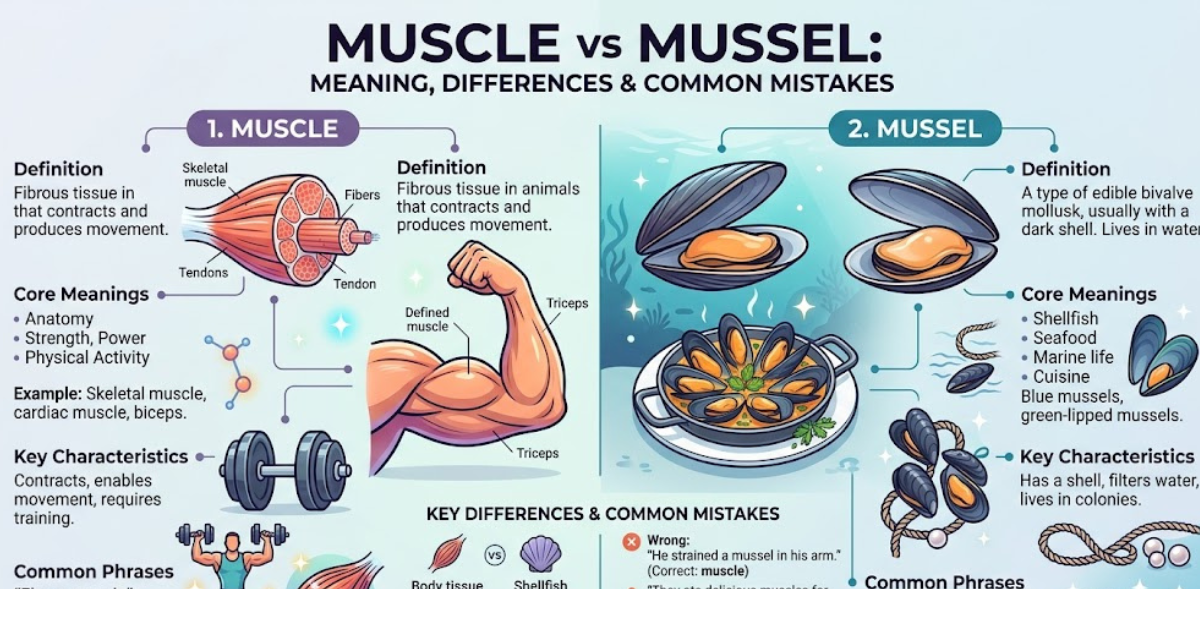
A muscle is a type of soft tissue in the body that contracts and relaxes to create movement. Humans and animals rely on muscles for everything from walking and breathing to lifting objects and maintaining posture.
The human body contains more than 600 muscles, which work together with bones, tendons, and the nervous system to allow movement.
Types of Muscles in the Human Body
There are three main types of muscles:
- Skeletal muscles
- Attached to bones.
- Responsible for voluntary movements like running, lifting, and writing.
- Cardiac muscles
- Found only in the heart.
- Pumps blood throughout the body without conscious effort.
- Smooth muscles
- Located in organs such as the stomach and blood vessels.
- Control involuntary functions like digestion.
Examples of Muscle in a Sentence
- She exercises daily to build stronger muscles.
- The athlete injured a leg muscle during training.
- Protein helps support muscle growth and recovery.
What Is a Mussel?
A mussel is an edible shellfish that belongs to the mollusk family. Mussels live in both saltwater and freshwater habitats and are known for their dark, hard shells that protect their soft bodies inside.
They are popular seafood around the world and are valued for their rich flavor and nutritional benefits.
Types of Mussels
Some common varieties include:
- Blue mussels – Commonly found in the Atlantic Ocean.
- Mediterranean mussels – Popular in European cuisine.
- Green-lipped mussels – Native to New Zealand and often used in supplements.
- Freshwater mussels – Found in rivers and lakes.
Examples of Mussel in a Sentence
- The restaurant served steamed mussels with garlic and herbs.
- Fishermen collected mussels from the rocky shoreline.
- Green-lipped mussels are used in some dietary supplements.
Muscle vs Mussel: The Key Differences
Although the words sound similar, their meanings are entirely unrelated.
| Feature | Muscle | Mussel |
| Definition | Tissue responsible for movement | A type of shellfish |
| Category | Human and animal anatomy | Marine or freshwater animal |
| Purpose | Enables movement and body functions | Lives as a filter-feeding organism |
| Location | Inside the body | Oceans, rivers, and lakes |
| Common Association | Fitness, strength, exercise | Seafood, cooking, marine life |
Why Do People Confuse Muscle and Mussel?
The main reason people mix up muscle vs mussel is their pronunciation. In many English accents, both words sound almost exactly the same.
These words are examples of homophones, meaning they share the same pronunciation but have different spellings and meanings.
Other examples of commonly confused homophones include:
- Their, there, and they’re
- Flour and flower
- Sea and see
- Right and write
How to Remember Muscle vs Mussel
A simple memory trick can help you remember the difference:
- Muscle has “cle” — think of clean strength and exercise.
- Mussel has “ss” — imagine the two “s” letters as two shells of a mussel closing together.
Another easy way to remember:
- If it helps you move, it’s a muscle.
- If it lives in water and has a shell, it’s a mussel.
The Pronunciation of Muscle and Mussel
The words are generally pronounced the same:
- Muscle: MUH-suhl
- Mussel: MUH-suhl
Because they are pronounced alike, context is the easiest way to determine which word is being used.
For example:
- “I pulled a muscle while exercising.” (Body tissue)
- “I ate a plate of mussels for dinner.” (Seafood)
Muscle vs Mussel in Everyday Life
Both words appear frequently but in completely different situations.
You will usually see muscle in topics related to:
- Fitness and bodybuilding
- Health and medicine
- Anatomy and sports
You will often see mussel in discussions about:
- Seafood recipes
- Marine biology
- Aquaculture and fishing
- Nutrition
Recognizing the context makes it easy to choose the correct word.
Common Spelling Mistakes to Avoid
Many people accidentally write “mussel pain” when they mean “muscle pain,” or “muscle soup” when referring to seafood.
Here are the correct forms:
Muscle growth
Muscle injury
Muscle strength
Steamed mussels
Freshwater mussels
Mussel shells
Paying attention to the subject of the sentence will prevent these errors.
FAQs About Muscle vs Mussel
Is it muscle or mussel pain?
The correct phrase is muscle pain because muscles are tissues in the body. Mussels are shellfish and cannot cause “mussel pain” in that context.
Are muscle and mussel pronounced the same?
Yes. In most English dialects, muscle and mussel are pronounced identically, making them homophones.
Is a mussel an animal?
Yes. A mussel is a living aquatic animal belonging to the mollusk family. It is a type of bivalve shellfish.
How many muscles are in the human body?
The human body contains more than 600 muscles that help with movement, posture, circulation, and many other essential functions.
Can you eat mussels?
Yes. Many species of mussels are edible and are considered a nutritious source of protein, vitamins, and minerals.
What is the easiest way to remember muscle vs mussel?
Remember that muscles are in your body and help you move, while mussels are shellfish that live in water.
Conclusion
The debate of muscle vs mussel comes down to understanding two words that sound the same but describe completely different things. A muscle is a vital part of the body responsible for movement and strength, whereas a mussel is an aquatic shellfish commonly eaten as seafood.
By remembering their meanings, recognizing the context, and using simple memory tricks, you can confidently choose the right word every time. If you enjoyed this guide, explore more articles on commonly confused words, English grammar tips, and vocabulary improvement techniques.