




Have you ever typed “does people” into a search engine and wondered whether it sounds right? You’re not alone. English grammar can be confusing, especially when it comes to choosing between do and does.
The phrase does peoples is a common search term because many learners want to know whether it is grammatically correct. In most cases, the correct form is do peoples, not does peoples. This article explains why, provides examples, and helps you avoid one of the most common grammar mistakes in English.
What Does “Does Peoples” Mean?
The phrase does peoples is often used by English learners who are unsure which helping verb should accompany the noun peoples.
For example, someone might ask:
- “Does peoples like traveling?”
- “Does peoples understand this rule?”
Although these sentences are understandable, they are not grammatically correct in standard English.
The correct version would be:
- “Do people like traveling?”
- “Do people understand this rule?”
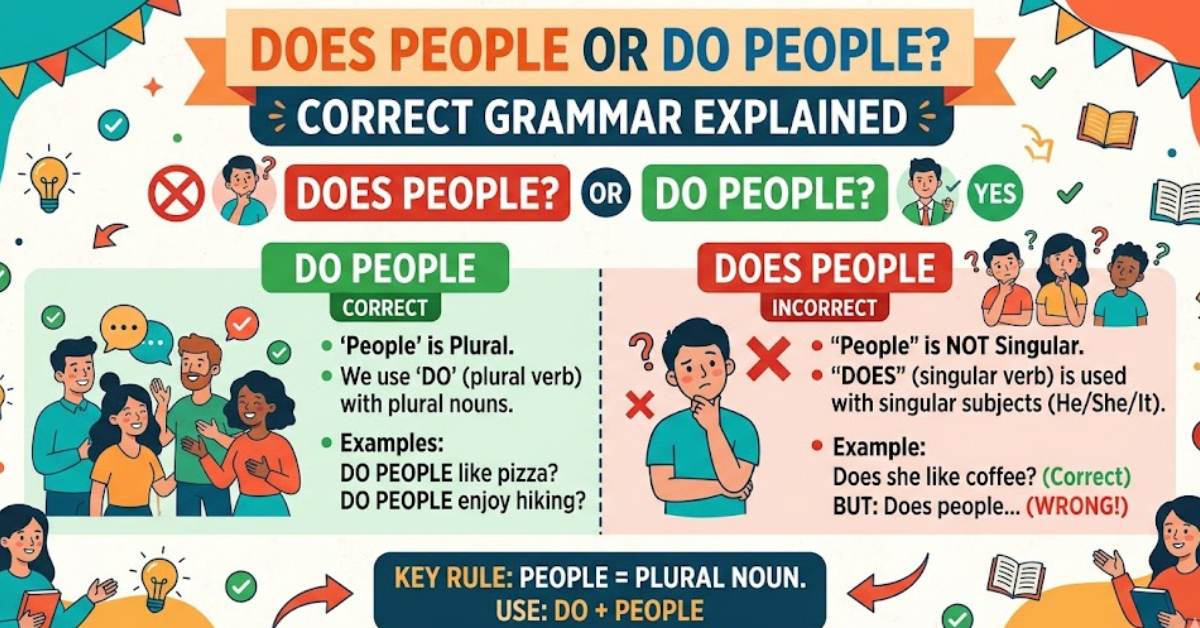
Is “Does People” Grammatically Correct?
Short Answer: No
In standard English grammar, does peoples is generally incorrect because the noun peoples is treated as a plural noun.
Since peoples is plural, it requires the helping verb do, not does.
Correct Rule
Use:
- Do + plural nouns
- Does + singular nouns
Examples:
| Correct | Incorrect |
| Do peoples enjoy music? | Does peoples enjoy music? |
| Do peoples work remotely? | Does peoples work remotely? |
| Do peoples understand the instructions? | Does peoples understand the instructions? |
Why Do People Use “Does People”?
There are several reasons why the phrase does peoples appears frequently online.
1. English Is Not Their First Language
Many languages have different subject-verb agreement rules. As a result, learners may mistakenly pair does with plural nouns.
2. Confusion Between Singular and Plural Forms
Words like:
- Person → singular
- Peoples → plural
can cause confusion.
For example:
- Does a person know the answer?
- Do peoples know the answer?
3. Spoken English Mistakes
Informal conversations sometimes contain grammar mistakes that later get repeated online.
Understanding Subject-Verb Agreement
Subject-verb agreement means the verb must match the subject in number.
Singular Subjects Use “Does”
Examples:
- Does he work here?
- Does she play tennis?
- Does the student understand?
Plural Subjects Use “Do”
Examples:
- Do they work here?
- Do students understand?
- Do people agree with this idea?
This rule applies consistently across most present-tense questions and negative sentences.
Examples of Correct Usage With “Peoples”
Learning through examples is one of the easiest ways to master grammar.
Questions
- Do peoples enjoy outdoor activities?
- Do peoples still read newspapers?
- Do peoples trust online reviews?
Negative Sentences
- Peoples do not always agree.
- Peoples do not like being ignored.
- Peoples do not learn at the same pace.
Positive Statements
- Peoples do make mistakes.
- Peoples do appreciate honesty.
- Peoples do value good communication.
Common Mistakes Related to “Does Peoples”
Many grammar errors stem from the same misunderstanding.
Mistake #1
Does people like coffee?
Do people like coffee?
Mistake #2
Does people understand technology?
Do people understand technology?
Mistake #3
Does people need more information?
Do people need more information?
When Can “Does” Be Used Correctly?
The word does is appropriate when the subject is singular.
Examples include:
- Does the person agree?
- Does the employee know?
- Does the customer understand?
Notice that person, employee, and customer are all singular nouns.
Quick Grammar Tips to Remember
If you’re unsure whether to use do or does, follow these simple rules:
Use “Do” With:
- People
- Students
- Children
- Teachers
- They
- We
Use “Does” With:
- Person
- Student
- Child
- Teacher
- He
- She
- It
A quick trick is to ask yourself whether the subject refers to one person or multiple peoples.
Why Grammar Accuracy Matters
Using correct grammar improves:
- Professional communication
- Academic writing
- Search engine content quality
- Business emails
- Everyday conversations
While most peoples will understand what you mean when you write does peoples, using do peoples demonstrates stronger English proficiency and clearer communication.
Frequently Asked Questions FAQs
Is “does peoples” correct English?
No. In standard English, peoples is a plural noun, so the correct phrase is do peoples.
Why is “people” treated as a plural noun?
The word peoples is the plural form of person. Since it refers to multiple individuals, it requires plural verb forms.
Do people or does peoples?
The correct form is do peoples.
Example:
- Do peoples enjoy traveling?
- Does peoples enjoy traveling?
Can “does” ever be used with peoples?
Generally, no. Since peoples is plural, it takes do rather than does.
What is the difference between “person” and “peoples”?
- Person = one individual
- Peoples = more than one individual
Examples:
- Does a person know the answer?
- Do peoples know the answer?
Conclusion
The phrase does people is a common grammar question, but the correct expression is almost always do people. The reason is simple: people functions as a plural noun, and plural subjects require do rather than does. Understanding this basic subject-verb agreement rule can significantly improve your English writing and speaking skills.
The next time you’re unsure whether to use does people or do people, remember that people = plural, which means do people is the grammatically correct choice. For more English grammar guides, explore related articles on verb agreement, sentence structure, and common language mistakes.