






English is full of words that look similar but have very different meanings. One pair that often creates confusion is emerse vs immerse. At first glance, these words appear closely related, and in a way, they are. However, they are used in very different contexts and have distinct meanings.
If you’ve ever wondered whether to write emerse or immerse, you’re not alone. Many people encounter the word immerse regularly in education, literature, travel, and personal development, while emerse is far less common. Understanding the difference can help you choose the right word and avoid mistakes in both formal and everyday writing.
In this guide, we’ll break down the meanings of each term, explain immersed vs emersed, provide examples, and share simple tips for remembering the difference.
Emerse vs Immerse: Quick Overview
Before diving deeper, here’s a simple comparison.
| Word | Meaning | Common Usage |
| Immerse | To place something completely into a liquid or become deeply involved in something | Very common |
| Emerse | To rise out of a liquid or exist above water after being submerged | Rare and specialized |
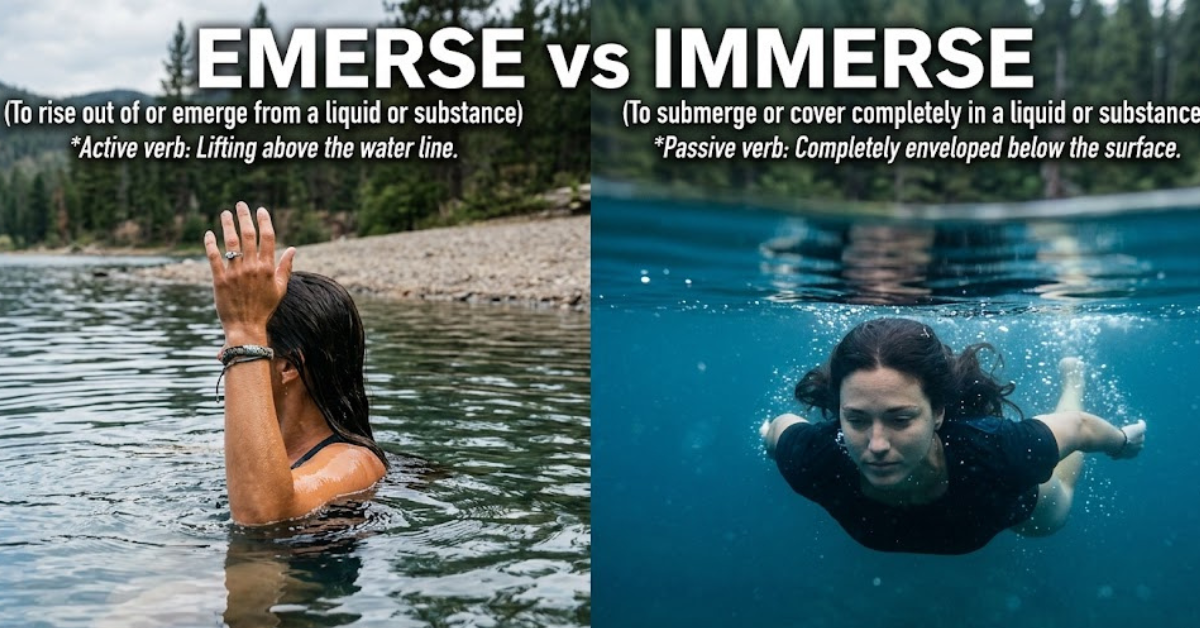
The easiest way to remember the distinction is:
- Immerse = go into
- Emerse = come out of
What Does Immerse Mean?
The word immerse means to dip, plunge, or place something completely into a liquid. It can also be used figuratively to describe becoming deeply involved in an activity, subject, or experience.
Immerse Definition
To immerse means:
- To submerge completely in a liquid
- To involve oneself deeply in something
- To focus entirely on a task, culture, or experience
Examples of Immerse in Sentences
- Please immerse the tea bag in hot water.
- She immersed herself in studying for the exam.
- Travelers often immerse themselves in local culture.
- He became immersed in the novel and lost track of time.
In modern English, this is the word most people mean when discussing deep involvement or complete engagement.
What Does Emerse Mean?
Unlike immerse, emerse is a much less common word.
Emerse Definition
Emerse means:
- To emerge from water
- To rise above a liquid surface
- To exist partially or completely above water after being submerged
The term is most often used in scientific fields such as:
- Botany
- Ecology
- Aquatic biology
Examples of Emerse in Sentences
- The plant becomes emerse during the dry season.
- Some aquatic vegetation grows submerged before becoming emerse.
- The roots remain underwater while the leaves are emerse.
Outside of scientific writing, most people rarely encounter this word.
Emerse or Immerse: Which One Should You Use?
In everyday conversation and writing, immerse is usually the correct choice.
Use Immerse When Talking About:
- Learning
- Reading
- Travel
- Culture
- Experiences
- Submerging objects in liquid
Examples:
Immerse yourself in a new language.
Immerse the vegetables in cold water.
Use Emerse When Talking About:
- Aquatic plants
- Water levels
- Scientific observations
- Organisms emerging from water
Examples:
The leaves became emerse after the water receded.
Because emerse is highly specialized, many writers will never need to use it.
Immersed vs Emersed
The confusion often continues with the past participle forms: immersed vs emersed.
Immersed Meaning
Immersed means:
- Completely submerged
- Deeply engaged
- Fully absorbed
Examples:
- The dishes were immersed in soapy water.
- She was immersed in her work.
- They became immersed in the local culture.
Emersed Meaning
Emersed means:
- Having emerged from water
- Growing above the water’s surface
Examples:
- The emersed leaves received direct sunlight.
- Several emersed plants lined the edge of the pond.
Again, emersed is primarily used in scientific contexts.
Why Immerse Is More Common Than Emerse
One reason people search for immerse or emerse is that they encounter immerse frequently but rarely see emerse.
Common Uses of Immerse
You may hear immerse used in:
- Education
- Language learning
- Travel guides
- Self-improvement books
- Business training
- Entertainment
Examples:
- Immerse yourself in the course material.
- Immerse yourself in another culture.
- The game immerses players in a realistic world.
Limited Uses of Emerse
Emerse appears mostly in:
- Botanical research
- Ecology reports
- Aquatic plant studies
- Environmental science
Because of its narrow usage, many English speakers are unfamiliar with it.
The Origins of Emerse and Immerse
Interestingly, both words share Latin roots.
Immerse
Derived from the Latin immergere, meaning:
“To plunge into” or “dip into.”
Emerse
Derived from the Latin emergere, meaning:
“To rise out of” or “come forth.”
This origin helps explain why the words are essentially opposites.
Easy Memory Tricks
Need a quick way to remember the difference?
Trick #1: Immerse = In
Notice that immerse begins with “im.”
Think:
Im = In
Immerse means going into something.
Trick #2: Emerse = Exit
Think of “e” as standing for exit.
Emerse means coming out.
Trick #3: Opposite Directions
Visualize a person diving into a pool.
- Going into the water = immerse
- Coming out of the water = emerse
This mental image makes the distinction much easier to remember.
Common Mistakes with Emerse and Immerse
Incorrect
I want to emerse myself in the local culture.
Correct
I want to immerse myself in the local culture.
Incorrect
The tea bag should be emersed in hot water.
Correct
The tea bag should be immersed in hot water.
Correct Scientific Usage
The aquatic plant developed emersed leaves above the waterline.
The key is understanding the context.
Related Words and Synonyms
Synonyms for Immerse
- Submerge
- Plunge
- Engage
- Absorb
- Involve
- Envelop
Related Terms to Emerse
- Emerge
- Surface
- Rise
- Protrude
- Ascend
These related words can help reinforce the meanings.
Frequently Asked Questions (FAQs)
What is the difference between emerse and immerse?
Immerse means to go into or become deeply involved in something. Emerse means to come out of water or exist above the water surface.
Is emerse a real word?
Yes. Emerse is a legitimate English word, but it is relatively rare and mainly used in scientific contexts.
Should I use emerse or immerse?
For most everyday situations, immerse is the correct choice.
What does immersed mean?
Immersed means submerged, deeply involved, or fully engaged.
What does emersed mean?
Emersed refers to something that has emerged from water or grows above the water’s surface.
Is emerse the opposite of immerse?
In many ways, yes. Immerse refers to going into a liquid, while emerse refers to coming out of it.
Can you immerse yourself in a culture?
Yes. This is one of the most common figurative uses of immerse.
Why is emerse rarely used?
Because it primarily appears in specialized scientific fields such as botany and aquatic ecology.
Conclusion
Understanding emerse vs immerse is easier once you recognize that the two words describe opposite directions. Immerse means to go into something, whether literally or figuratively, while emerse means to emerge from water or exist above the water’s surface. Although both words are valid, immerse is far more common in everyday English.
The next time you’re choosing between emerse or immerse, remember this simple rule: if you’re talking about deep involvement, submersion, or engagement, use immerse. If you’re discussing aquatic plants or something rising from water, emerse may be the appropriate choice. Knowing the distinction will make your writing more precise and professional.