






English is full of words that look similar but carry completely different meanings. One common source of confusion is shining or shinning. Many people wonder whether “shinning” is simply an alternate spelling of “shining” or if it has a separate meaning altogether.
If you’ve ever written phrases like “the sun was shinning” or “a shinning star”, you’re not alone. Understanding the difference between shining vs shinning can help you write more accurately and confidently. This guide explains the meanings, proper usage, examples, and common mistakes related to these two words.
Understanding Shining or Shinning
At first glance, shining and shinning seem nearly identical. However, they are not interchangeable.
- Shining relates to giving off light, glowing, or standing out.
- Shinning refers to climbing something using the hands and legs, especially a pole, rope, or tree.
The confusion often arises because both words are derived from verbs and differ by only one letter.
What Does “Shining” Mean?
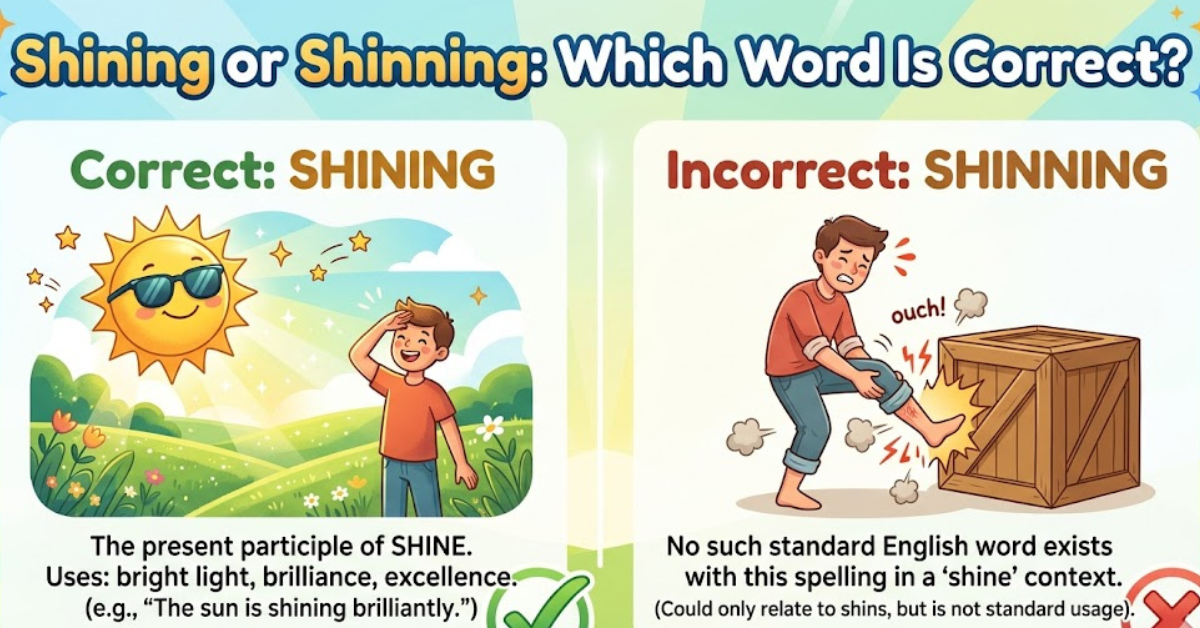
The word shining is the present participle of the verb shine.
Definition of Shining
Shining means:
- Emitting light
- Reflecting brightness
- Looking polished or radiant
- Excelling or standing out
Examples of Shining
- The sun is shining brightly today.
- She wore a shining silver dress.
- His shining performance impressed everyone.
- The stars were shining in the night sky.
In most everyday situations, shining is the word people intend to use.
What Does “Shinning” Mean?
The word shinning comes from the verb shin, which means to climb by gripping with the arms and legs.
Definition of Shinning
Shinning refers to:
- Climbing a tree trunk
- Climbing a rope
- Moving up a pole using hands and feet
Examples of Shinning
- The child was shinning up the tree.
- The firefighter practiced shinning down a rope.
- He spent the afternoon shinning up palm trees.
While grammatically correct, shinning is far less common than shining.
Shining vs Shinning: Key Differences
Understanding shining vs shinning becomes easier when you compare them directly.
| Word | Meaning | Example |
| Shining | Giving off light or brilliance | The moon is shining tonight. |
| Shinning | Climbing using hands and legs | He was shinning up the pole. |
Quick Memory Trick
Think of the word shin (the front part of your leg).
When you’re climbing a tree or pole, your shins often press against the surface. That’s why shinning relates to climbing.
Meanwhile, shining comes from shine, which means brightness or light.
Shinning or Shining Star: Which Is Correct?
One of the most searched questions is “shinning or shining star?”
The correct phrase is:
Shining star
Incorrect:
Shinning star
Why?
A star emits light and appears bright. It does not climb trees or poles. Therefore, the proper word is shining.
Examples:
- She is the shining star of the team.
- The bright planet looked like a shining star in the sky.
- His success made him the shining star of the company.
The phrase shining star is also commonly used as a metaphor for someone exceptional or talented.
Shining or Shinning Meaning Explained
When discussing shining or shinning meaning, context is everything.
Use Shining When Referring To:
- Light
- Brightness
- Success
- Excellence
- Reflection
Examples:
- A shining example
- Shining sunlight
- Shining armor
- Shining achievement
Use Shinning When Referring To:
- Climbing
- Scaling a rope
- Moving up a tree trunk
- Climbing a pole
Examples:
- Shinning up a coconut tree
- Shinning down a rope
- Shinning a flagpole
Common Mistakes People Make
Many writers accidentally use shinning when they mean shining.
Incorrect Examples
The sun is shinning.
Her eyes were shinning with happiness.
We saw a shinning star.
Correct Versions
The sun is shining.
Her eyes were shining with happiness.
We saw a shining star.
These mistakes occur because English spelling rules can sometimes be confusing, especially when adding “-ing” to verbs.
Why Do People Misspell Shining as Shinning?
The error often stems from assumptions about spelling patterns.
Consider these examples:
- Run → Running
- Sit → Sitting
- Swim → Swimming
Because many short verbs double the final consonant before adding “-ing,” some people incorrectly assume:
- Shine → Shinning
However, the correct form is:
- Shine → Shining
The silent “e” is dropped before adding “-ing.”
Grammar Rule Behind Shining
The verb shine follows a common English spelling rule.
Rule:
When a verb ends in a silent e, remove the e before adding -ing.
Examples:
- Shine → Shining
- Dance → Dancing
- Drive → Driving
- Write → Writing
This rule explains why shining is correct.
Examples of Shining in Everyday Language
Here are some common phrases that use shining correctly:
Literal Usage
- The sun is shining.
- The lamp is shining brightly.
- The polished floor is shining.
Figurative Usage
- A shining example of leadership.
- Her shining personality attracted everyone.
- The company had a shining reputation.
These expressions appear frequently in books, articles, speeches, and everyday conversations.
Examples of Shinning in Context
Although uncommon, shinning remains a valid English word.
Examples
- The worker was shinning up the utility pole.
- The child enjoyed shinning trees in the backyard.
- Sailors practiced shinning up the ship’s rigging.
- He quickly began shinning down the rope.
Most modern speakers rarely encounter this word unless discussing climbing techniques.
When to Use Shining and When to Use Shinning
Use “Shining” If You Mean:
- Brightness
- Light
- Reflection
- Excellence
- Success
Use “Shinning” If You Mean:
- Climbing a tree
- Climbing a rope
- Climbing a pole
- Scaling a vertical object
In over 95% of everyday writing situations, shining is likely the word you need.
Frequently Confused Phrases
Here are some common phrases and their correct forms:
| Phrase | Correct? |
| Shining star | Yes |
| Shinning star | No |
| Sun shining | Yes |
| Sun shinning | No |
| Shining example | Yes |
| Shinning example | No |
| Shinning up a tree | Yes |
| Shining up a tree | Usually No |
FAQs About Shining or Shinning
Is it shining or shinning?
It depends on the meaning. Shining refers to brightness or light, while shinning means climbing a rope, tree, or pole.
Is “the sun is shinning” correct?
No. The correct sentence is “The sun is shining.”
What is the difference between shining vs shinning?
Shining means glowing, bright, or outstanding. Shinning means climbing using your hands and legs.
Is “shinning” a real word?
Yes. Shinning is a legitimate English word, but it specifically refers to climbing.
Is it a shining star or a shinning star?
The correct phrase is “shining star.”
Why do people spell shining as shinning?
Many people mistakenly apply spelling rules used for words like running and swimming. However, shine becomes shining, not shinning.
Can shinning be used figuratively?
Rarely. Most uses of shinning refer to physical climbing rather than metaphorical meanings.
Conclusion
The debate over shining or shinning is easy to settle once you understand the meanings. Shining refers to brightness, light, excellence, or radiance, while shinning means climbing a tree, rope, or pole using your hands and legs.
When writing phrases like “shining star,” “sun shining,” or “shining example,” the correct choice is almost always shining. The word shinning has a much narrower use and appears mainly in descriptions of climbing.