







Have you ever woken up and wondered why your phone and microwave are showing different times? Every spring, millions of people across the UK adjust to a one-hour time change that marks the start of longer, brighter evenings.
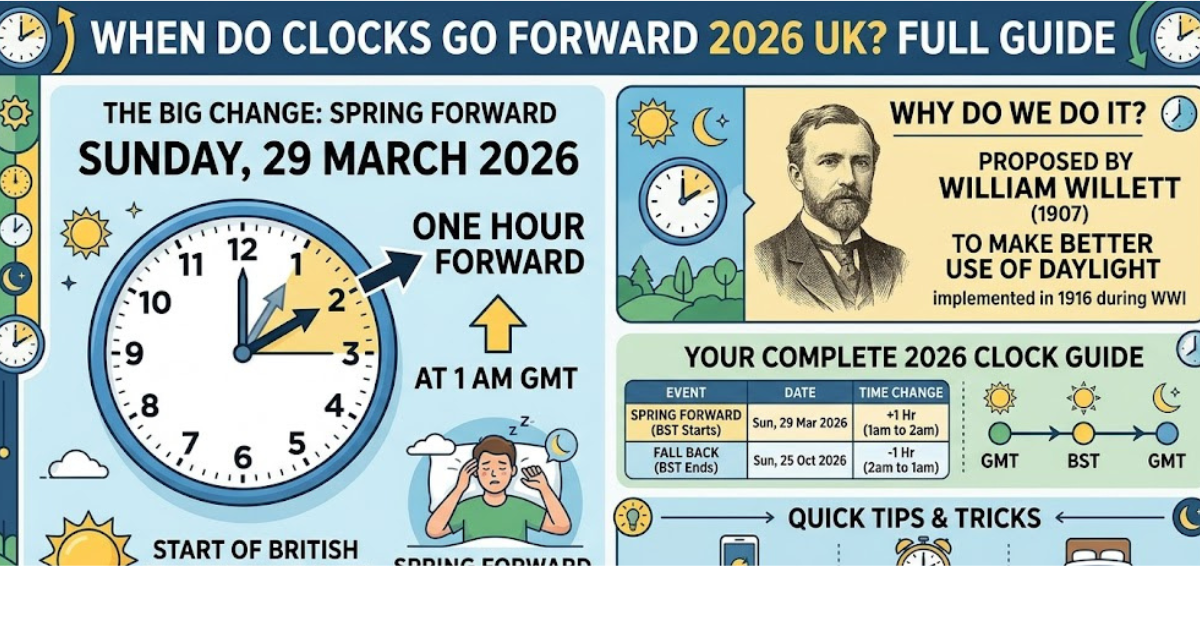
If you’re asking when do clocks go forward 2026 UK, the answer is simple: clocks will go forward by one hour at 1:00 am GMT on Sunday, 29 March 2026. At that moment, the clocks move ahead to 2:00 am, marking the beginning of British Summer Time (BST).
In this guide, you’ll learn exactly when the clocks change in 2026, why the UK observes daylight saving time, how it affects daily life, and answers to common questions people search for every year.
When Do Clocks Go Forward in 2026 UK?
The UK will move from Greenwich Mean Time (GMT) to British Summer Time (BST) on:
Sunday, 29 March 2026
What Happens During the Change?
At 1:00 am GMT, clocks move forward one hour to 2:00 am BST.
This means:
- You lose one hour of sleep that night.
- Sunsets occur later in the evening.
- Daylight lasts longer after work and school.
- The UK officially enters British Summer Time.
Many modern devices such as smartphones, laptops, tablets, and smartwatches update automatically. However, some household clocks and appliances may need manual adjustment.
Understanding British Summer Time (BST)
British Summer Time is the period during which the UK advances its clocks by one hour to make better use of daylight during the warmer months.
Why Does BST Exist?
The primary goal is to maximize daylight hours during the evening.
Benefits include:
- Reduced need for artificial lighting
- More daylight for outdoor activities
- Potential energy savings
- Improved road safety during evening commuting hours
- Increased opportunities for leisure and tourism
BST typically runs from late March until late October.
Why Do Clocks Go Forward in the UK?
The practice is commonly known as Daylight Saving Time (DST).
Historical Background
The idea gained popularity in the early 20th century as a way to conserve energy and make better use of natural daylight.
The UK first adopted daylight saving measures during World War I. Since then, clock changes have become a regular part of the annual calendar.
Today, the UK follows a standardized schedule in line with many European countries.
UK Clock Change Dates for 2026
To fully understand the annual time change cycle, it’s helpful to know both key dates.
| Event | Date | Time Change |
| Clocks Go Forward | Sunday, 29 March 2026 | 1:00 am → 2:00 am |
| Clocks Go Back | Sunday, 25 October 2026 | 2:00 am → 1:00 am |
A simple way to remember this is:
Spring Forward, Fall Back
In spring, clocks move ahead one hour. In autumn, they return to standard time.
How Does the Time Change Affect Daily Life?
The shift to BST influences many aspects of everyday life.
Sleep Patterns
Many people notice temporary disruptions to their sleep schedule.
Common effects include:
- Feeling tired for a few days
- Difficulty falling asleep earlier
- Reduced alertness immediately after the change
Most people adapt within several days.
Work and School Routines
The lost hour can make Monday mornings feel challenging, especially for children and early commuters.
Preparing a few days in advance by adjusting bedtime can help ease the transition.
Travel and Transportation
Airlines, rail services, and public transport operators update schedules according to official time changes.
When traveling near the clock change date:
- Double-check departure times
- Confirm international connections
- Verify hotel check-in arrangements
Benefits of Longer Evening Daylight
One of the biggest advantages of BST is extended daylight during the evening.
More Outdoor Activities
Longer evenings encourage:
- Walking and cycling
- Sports and recreation
- Gardening
- Family activities outdoors
Economic Benefits
Many businesses benefit from additional daylight.
Industries that often see advantages include:
- Hospitality
- Tourism
- Retail
- Outdoor entertainment
Improved Well-Being
Access to natural daylight may contribute to:
- Better mood
- Increased physical activity
- Greater social engagement
While experiences vary, many people appreciate the brighter evenings that BST provides.
Which Countries Change Their Clocks?
The UK is not alone in observing seasonal time changes.
Countries and regions that commonly use daylight saving systems include:
- Ireland
- Germany
- France
- Italy
- Spain
- United States (most states)
- Canada (many provinces)
- Australia (selected regions)
However, not all countries participate. Some nations have discontinued daylight saving time altogether.
Tips for Adjusting to the 2026 Clock Change
The transition can feel easier with a little preparation.
1. Shift Your Sleep Schedule Gradually
Move bedtime and wake-up time 10–15 minutes earlier for several days before the change.
2. Get Morning Sunlight
Natural light helps regulate your body’s internal clock.
3. Avoid Late-Night Caffeine
Reducing caffeine intake in the evening can improve sleep quality.
4. Check Manual Clocks
Don’t forget to update:
- Wall clocks
- Oven clocks
- Car clocks
- Alarm clocks
- Watches
5. Plan Important Activities
If you have an early meeting, flight, or event on the clock-change weekend, double-check the correct time.
Key Facts About the UK Clock Change
Here are some quick facts worth remembering:
- The clocks go forward on Sunday, 29 March 2026.
- The change happens at 1:00 am GMT.
- Clocks advance by one hour to 2:00 am BST.
- British Summer Time lasts until 25 October 2026.
- Most smartphones and internet-connected devices update automatically.
- The purpose is to make better use of daylight during spring and summer.
FAQ: When Do Clocks Go Forward 2026 UK?
When do clocks go forward 2026 UK exactly?
The clocks go forward on Sunday, 29 March 2026 at 1:00 am GMT. They move ahead one hour to 2:00 am BST.
Do we lose an hour of sleep when clocks go forward?
Yes. Because the clocks advance by one hour, most people effectively lose one hour of sleep on the night of the change.
What time do the clocks change in the UK?
The change occurs at 1:00 am GMT. The clock immediately becomes 2:00 am BST.
Will my phone update automatically?
Most smartphones, tablets, computers, and smartwatches connected to the internet update automatically. Manual clocks may still need adjusting.
Why does the UK use British Summer Time?
British Summer Time helps maximize evening daylight during spring and summer months, supporting outdoor activities and potentially reducing energy use.
When do clocks go back in 2026?
The clocks go back on Sunday, 25 October 2026, when the UK returns from BST to GMT.
Conclusion
If you’ve been wondering when do clocks go forward 2026 UK, mark your calendar for Sunday, 29 March 2026. At 1:00 am GMT, clocks move forward to 2:00 am BST, bringing longer evenings and the official start of British Summer Time.
Although losing an hour of sleep can be an adjustment, the reward is more daylight after work, school, and daily activities. By preparing in advance and understanding how the change works, you can make the transition smoother and enjoy the benefits of brighter spring and summer evenings. Keep this date in mind and check your manual clocks so you’re ready when the change arrives.