








Have you ever found yourself repeating the famous phrase, “How much wood could a woodchuck chuck if a woodchuck could chuck wood?” It’s one of the most recognizable tongue twisters in the English language, but have you ever wondered whether there’s an actual answer behind it?
The question how much wood could a woodchuck chuck has fascinated children, linguists, wildlife enthusiasts, and curious minds for generations. While it began as a playful language exercise, researchers have even attempted to calculate a scientific answer. In this article, we’ll explore the origins of the phrase, the truth about woodchucks, and the surprising estimates that have turned a simple tongue twister into a cultural phenomenon.
What Is a Woodchuck?
Before answering the famous question, it’s important to understand what a woodchuck actually is.
A woodchuck, also known as a groundhog (Marmota monax), is a large rodent native to North America. Woodchucks belong to the squirrel family and are best known for:
- Digging extensive burrow systems
- Hibernating during winter
- Appearing in the annual Groundhog Day tradition
- Living in fields, forests, and grasslands
Despite their name, woodchucks do not typically chuck, throw, or move wood as part of their daily behavior.
Why Are They Called Woodchucks?
The name “woodchuck” is believed to come from the Native American Algonquian word “wuchak” or a similar term. Interestingly, the name has nothing to do with wood or chucking.
This linguistic coincidence helped create one of the most memorable tongue twisters ever invented.
The Origin of the Tongue Twister
The phrase became widely popular in the early 20th century.
Many historians trace the tongue twister to songwriter Robert Hobart Davis, who wrote a piece called “The Woodchuck Song” in 1902. The catchy phrase quickly spread across the United States and eventually became part of popular culture.
Its appeal comes from the repetition of similar sounds:
- Wood
- Would
- Woodchuck
- Chuck
These repeated consonant sounds make the sentence challenging to pronounce quickly, which is exactly what makes a great tongue twister.
How Much Wood Could a Woodchuck Chuck If a Woodchuck Could Chuck Wood?
The traditional answer is:
“A woodchuck would chuck all the wood a woodchuck could chuck if a woodchuck could chuck wood.”
While amusing, this doesn’t provide a numerical answer.
Fortunately, scientists have tried to estimate one.
The Scientific Answer
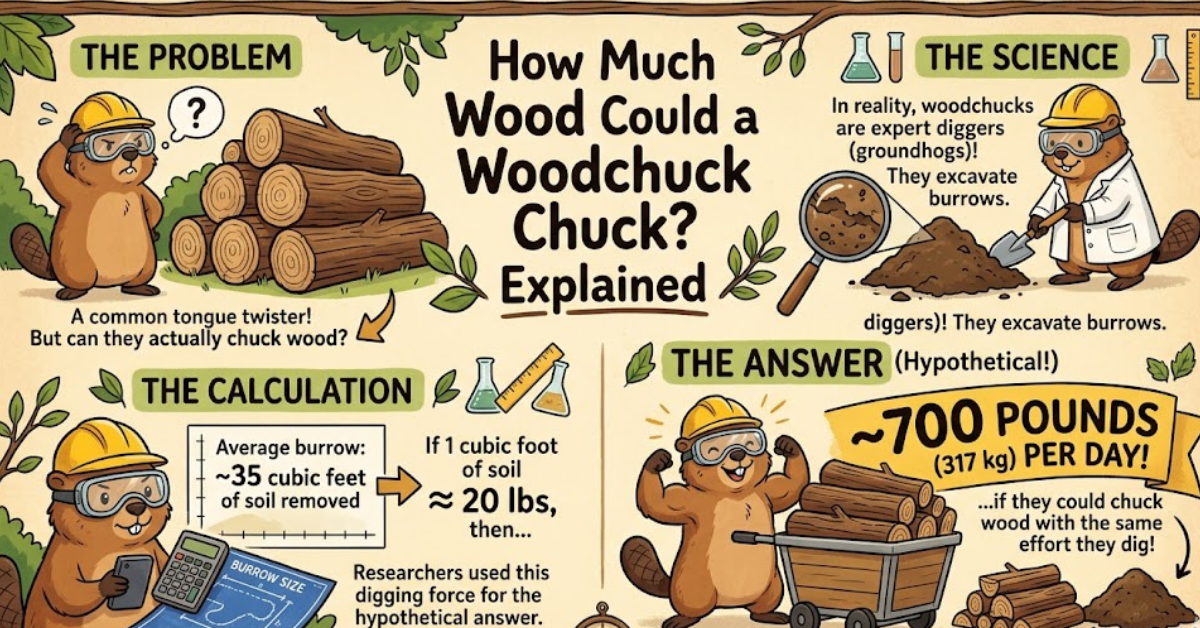
In 1988, wildlife expert Richard Thomas attempted to solve the mystery scientifically.
Instead of focusing on actual wood, Thomas studied how much dirt a woodchuck moves when digging burrows.
His Method
Thomas calculated:
- The average size of a woodchuck burrow
- The volume of soil removed
- The equivalent weight of that material
Based on these calculations, he estimated that a woodchuck could move approximately:
700 pounds (about 318 kilograms) of material
If woodchucks were capable of chucking wood in the same way they move dirt, they could theoretically chuck around 700 pounds of wood.
This estimate became the most widely cited answer to the famous question.
Why Woodchucks Don’t Actually Chuck Wood
Despite the popular phrase, woodchucks are not known for handling wood.
Their primary activities include:
- Digging tunnels
- Gathering vegetation
- Feeding on plants
- Building underground shelters
Unlike beavers, which actively cut and move wood, woodchucks rarely interact with timber in a meaningful way.
Comparing Woodchucks and Beavers
| Animal | Main Activity | Moves Wood? |
| Woodchuck | Digging burrows | Rarely |
| Beaver | Building dams | Yes |
| Squirrel | Collecting nuts | Occasionally |
| Groundhog | Foraging and digging | No significant wood movement |
This comparison highlights why the tongue twister is humorous—it describes an activity that woodchucks don’t normally perform.
Why the Question Became So Popular
The phrase has remained popular for more than a century because it combines several appealing elements.
It’s Fun to Say
The repeating sounds challenge pronunciation and make the phrase entertaining.
It’s Memorable
Most people hear it during childhood and remember it for life.
It Sparks Curiosity
People naturally want to know whether there’s a real answer behind the question.
It Bridges Language and Science
What starts as a linguistic challenge often leads people to learn about wildlife, biology, and history.
Cultural Impact of the Woodchuck Question
The phrase has become deeply embedded in English-speaking culture.
You’ll find it in:
- School classrooms
- Speech therapy exercises
- Language-learning programs
- Comedy routines
- Children’s books
- Trivia competitions
Speech coaches often use it to help improve articulation and pronunciation because it requires careful control of consonant sounds.
Other Popular Interpretations
Over the years, people have offered creative answers to the question.
Some humorous responses include:
- “As much wood as a woodchuck could chuck.”
- “None, because woodchucks don’t chuck wood.”
- “Exactly 700 pounds.”
- “Enough to build a cabin.”
These playful interpretations help keep the tongue twister alive across generations.
Fun Facts About Woodchucks
Here are some interesting facts about these fascinating animals:
They Are Excellent Diggers
A woodchuck can create burrows with multiple chambers and entrances.
They Can Climb Trees
Although they spend much of their time on the ground, woodchucks can climb when necessary.
They Hibernate
Woodchucks are among the few mammals that truly hibernate for extended periods.
They Are Surprisingly Fast
When threatened, a woodchuck can run at speeds of up to 8 miles per hour (13 km/h).
Groundhog Day Stars
The famous Groundhog Day tradition centers around a woodchuck predicting the arrival of spring.
Key Takeaways
- A woodchuck is actually a groundhog native to North America.
- The phrase originated as a tongue twister and became popular in the early 1900s.
- Woodchucks do not normally move wood.
- Researcher Richard Thomas estimated that a woodchuck could theoretically chuck about 700 pounds of wood.
- The question remains popular because it combines language, humor, and curiosity.
Frequently Asked Questions
How much wood could a woodchuck chuck if a woodchuck could chuck wood?
According to a commonly cited scientific estimate, a woodchuck could theoretically chuck around 700 pounds of wood if it moved wood the same way it moves dirt while digging burrows.
Do woodchucks actually chuck wood?
No. Woodchucks do not normally move or throw wood. They are primarily digging animals that create underground burrows.
Why is it called a woodchuck?
The name likely comes from an Algonquian Native American word. It is not related to wood or the act of chucking.
Who created the woodchuck tongue twister?
The phrase gained popularity through Robert Hobart Davis’s 1902 composition known as The Woodchuck Song.
Is a woodchuck the same as a groundhog?
Yes. Woodchuck and groundhog are two names for the same animal, Marmota monax.
Why is the phrase difficult to say?
The tongue twister uses repeated consonant sounds and similar word structures, making rapid pronunciation challenging.
Conclusion
The famous question how much wood could a woodchuck chuck began as a clever tongue twister, but it has grown into a fascinating blend of language, folklore, and science. While woodchucks don’t actually chuck wood, researchers have estimated that a hardworking woodchuck could theoretically move about 700 pounds of material. Whether you’re practicing pronunciation, teaching language skills, or simply satisfying your curiosity, this classic phrase continues to entertain and educate more than a century after it first became popular.
The next time someone asks the question, you’ll have more than just a tongue-twisting answer—you’ll have the science and history behind it too.