









Have you ever stood up after hours at a desk and felt a dull ache in your lower back? Or noticed stiffness between your shoulders after scrolling on your phone? You’re not alone.
Many people wonder, how can poor posture result in back pain? The answer lies in how the body distributes weight, supports movement, and maintains spinal alignment throughout the day. Even small postural habits, when repeated over months or years, can place significant stress on muscles, joints, ligaments, and spinal discs.
In this guide, you’ll learn exactly how poor posture affects the back, why it causes pain, the warning signs to watch for, and practical strategies to improve your posture and reduce discomfort.
Understanding Posture and Why It Matters
Posture refers to the way you hold your body while sitting, standing, walking, or lying down. Good posture keeps the body’s structures aligned so that muscles and joints work efficiently.
When posture is balanced:
- The spine maintains its natural curves.
- Muscles work with minimal strain.
- Joints move freely.
- Weight is evenly distributed throughout the body.
Poor posture, on the other hand, disrupts this balance and forces certain structures to work harder than they should.
What Is Considered Poor Posture?
Common examples include:
- Slouching while sitting
- Rounded shoulders
- Forward head position (“text neck”)
- Leaning to one side when standing
- Excessive arching of the lower back
- Hunching over a computer or smartphone
These positions may seem harmless at first, but they can create ongoing stress on the musculoskeletal system.
How Can Poor Posture Result in Back Pain?
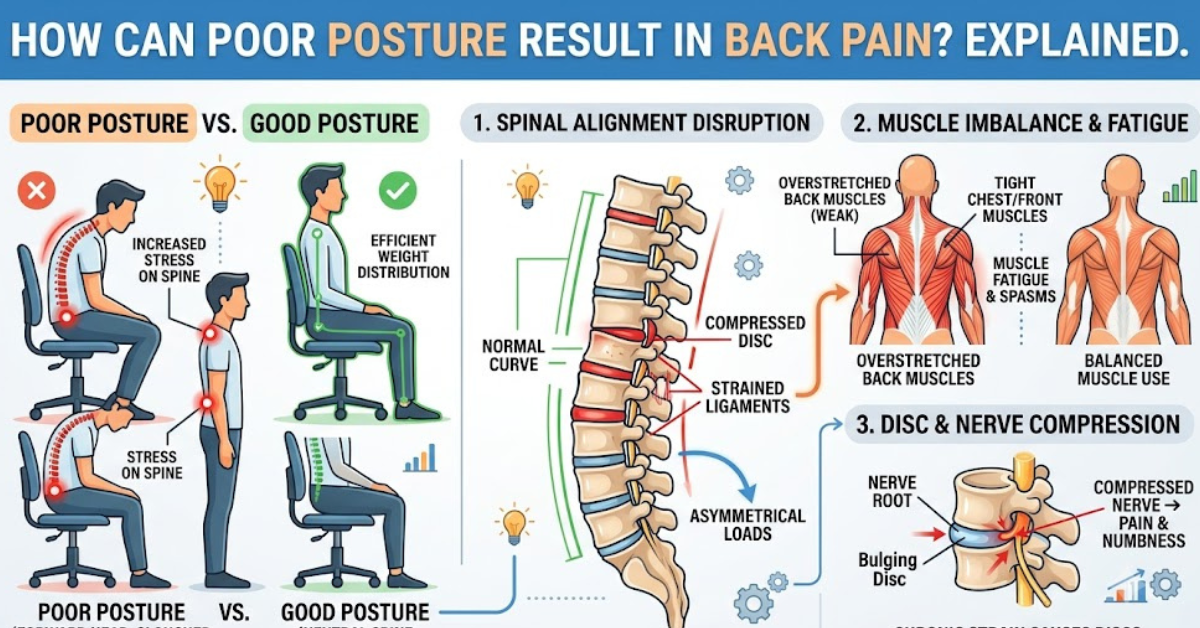
The primary reason poor posture causes back pain is that it changes the way forces travel through the spine.
Instead of allowing muscles, bones, and joints to share the workload evenly, poor alignment places excessive pressure on specific areas.
Over time, this can lead to:
- Muscle fatigue
- Joint irritation
- Ligament strain
- Disc compression
- Chronic inflammation
Let’s look at the mechanisms in greater detail.
Increased Muscle Strain
Muscles Have to Work Harder
When you maintain a slouched or hunched position, certain muscles remain under constant tension.
For example:
- Neck muscles work harder to support a forward head.
- Upper back muscles become overstretched.
- Lower back muscles compensate for poor alignment.
Eventually, these muscles become fatigued, leading to soreness and stiffness.
Muscle Imbalances Develop
Poor posture often creates an imbalance between strong and weak muscles.
Common patterns include:
- Tight chest muscles
- Weak upper back muscles
- Tight hip flexors
- Weak abdominal muscles
These imbalances alter movement patterns and contribute to persistent back discomfort.
Excessive Pressure on the Spine
The spine is designed to support body weight efficiently when properly aligned.
Increased Disc Compression
Spinal discs act as cushions between vertebrae.
When posture deteriorates:
- Certain discs experience uneven pressure.
- Compression increases in specific regions.
- Disc degeneration may accelerate over time.
Research has shown that prolonged sitting in a slouched position can significantly increase pressure on the lumbar spine compared to standing with proper alignment.
Stress on Vertebral Joints
Poor posture can also overload the facet joints, which help guide spinal movement.
Excessive joint stress may contribute to:
- Localized pain
- Reduced mobility
- Inflammation
- Degenerative changes
Ligament and Soft Tissue Strain
Ligaments connect bones and help stabilize joints.
Prolonged Stretching Causes Problems
When posture is consistently poor, some ligaments remain stretched beyond their ideal range.
Over time, this can lead to:
- Reduced stability
- Tissue irritation
- Chronic discomfort
- Increased injury risk
Unlike muscles, ligaments do not recover quickly from ongoing strain, making postural correction especially important.
Forward Head Posture and Back Pain
One of the most common modern posture issues is forward head posture.
The Weight Problem
The human head typically weighs around 10–12 pounds (4.5–5.5 kilograms).
When the head moves forward:
- The effective load on the neck increases dramatically.
- Upper back muscles work harder.
- The shoulders round forward.
- The entire spinal alignment changes.
This chain reaction often causes pain extending from the neck into the upper and middle back.
The Smartphone Effect
Hours spent looking down at phones, tablets, and laptops contribute significantly to:
- Neck strain
- Shoulder tension
- Upper back pain
- Headaches
This condition is commonly referred to as “text neck.”
How Sitting Posture Contributes to Back Pain
Modern lifestyles involve long periods of sitting.
Why Sitting Can Be Problematic
When sitting incorrectly:
- The pelvis tilts backward.
- The lower spine loses its natural curve.
- Core muscles become less active.
- Lumbar discs experience greater pressure.
The longer this position is maintained, the greater the likelihood of discomfort.
Common Sitting Mistakes
- Sitting at the edge of the chair
- Slouching toward a screen
- Crossing legs for extended periods
- Using poorly adjusted desks
- Lack of lumbar support
Standing Posture and Back Problems
Many people associate posture issues only with sitting, but standing posture matters too.
Common Standing Errors
These include:
- Locking the knees
- Leaning on one leg
- Excessive lower-back arching
- Rounded shoulders
Such habits create uneven weight distribution and force muscles to compensate continuously.
The result can be lower back pain, hip discomfort, and muscle fatigue.
Long-Term Effects of Poor Posture
If left unaddressed, poor posture can contribute to more than temporary discomfort.
Potential Consequences
Long-term postural issues may lead to:
- Chronic back pain
- Reduced flexibility
- Joint degeneration
- Muscle weakness
- Limited mobility
- Increased risk of injury
- Neck and shoulder pain
- Tension headaches
While poor posture alone may not cause serious spinal disease, it can significantly worsen existing musculoskeletal problems.
Signs Your Back Pain May Be Related to Poor Posture
Wondering whether your discomfort is posture-related?
Common indicators include:
- Pain after prolonged sitting
- Stiffness upon standing
- Aching between the shoulder blades
- Frequent neck tension
- Symptoms that improve with movement
- Rounded shoulders
- Forward head position
- Fatigue after standing for long periods
These signs often point toward postural strain rather than an acute injury.
How to Improve Posture and Reduce Back Pain
The good news is that posture can often be improved with consistent effort.
Strengthen Core Muscles
A strong core helps support spinal alignment.
Focus on:
- Planks
- Bird-dogs
- Dead bugs
- Pelvic tilts
Improve Ergonomics
Adjust your workspace so that:
- Screens are at eye level.
- Feet rest flat on the floor.
- Knees are at a 90-degree angle.
- Arms are comfortably supported.
Move More Frequently
Avoid remaining in one position for hours.
Try:
- Standing every 30–60 minutes
- Walking during breaks
- Gentle stretching throughout the day
Stretch Tight Muscles
Helpful stretches include:
- Chest stretches
- Hip flexor stretches
- Hamstring stretches
- Upper back mobility exercises
Practice Postural Awareness
Simple reminders can make a significant difference.
Ask yourself regularly:
- Are my shoulders relaxed?
- Is my head aligned with my shoulders?
- Am I slouching?
Small corrections repeated throughout the day can gradually improve posture.
Can Good Posture Eliminate Back Pain Completely?
Not always.
Back pain can have many causes, including:
- Herniated discs
- Arthritis
- Spinal stenosis
- Injuries
- Medical conditions
However, improving posture often reduces strain on the spine and may significantly decrease pain, especially when poor alignment is a contributing factor.
If pain is severe, persistent, or accompanied by numbness, weakness, or loss of bladder control, medical evaluation is essential.
Key Takeaways
- Poor posture alters spinal alignment and increases stress on muscles, joints, and discs.
- Slouching, forward head posture, and prolonged sitting are common contributors to back pain.
- Muscle fatigue, ligament strain, and disc compression play major roles in discomfort.
- Posture-related pain often improves with movement and ergonomic changes.
- Strengthening the core, stretching regularly, and maintaining proper alignment can help reduce symptoms.
Frequently Asked Questions
1. How can poor posture result in back pain over time?
Poor posture places uneven pressure on the spine, muscles, and ligaments. Over months or years, this repetitive strain can lead to chronic pain, stiffness, and reduced mobility.
2. Can sitting too much cause posture-related back pain?
Yes. Prolonged sitting, especially with a slouched posture, increases pressure on spinal discs and weakens supporting muscles, which can contribute to back pain.
3. Is forward head posture linked to back pain?
Absolutely. Forward head posture shifts weight away from the body’s center of gravity, forcing neck and upper back muscles to work harder and increasing strain throughout the spine.
4. How long does it take to correct poor posture?
The timeline varies depending on the severity of the issue and consistency of corrective habits. Many people notice improvements within a few weeks, while lasting changes may take several months.
5. Can exercise help improve posture and relieve back pain?
Yes. Strengthening the core, back, and shoulder muscles can improve spinal support, enhance posture, and reduce discomfort caused by muscle imbalances.
6. What is the best sleeping position for posture-related back pain?
Sleeping on your back or side with proper support generally helps maintain spinal alignment. A supportive mattress and pillow can also reduce strain on the back.
Conclusion
So, how can poor posture result in back pain? The answer comes down to biomechanics. Poor alignment forces muscles, ligaments, joints, and spinal discs to absorb stress they were never designed to handle continuously. Over time, this leads to fatigue, tension, stiffness, and persistent discomfort.
The encouraging news is that posture is often a modifiable factor. By improving ergonomics, strengthening supportive muscles, staying active, and paying attention to body alignment, many people can reduce or even prevent posture-related back pain. Start with small adjustments today, and your spine will thank you for years to come.