








Can the way a single state draws its voting districts influence laws that affect an entire country? Surprisingly, the answer is yes.
Many people think political boundaries only affect local elections, but how can a state’s gerrymandering impact government at the national level? The effects can reach far beyond state borders, influencing congressional representation, national policy decisions, and even the balance of power in Washington, D.C.
In this article, you’ll learn what gerrymandering is, how it works, why it matters, and the significant ways it can shape the federal government and national politics.
What Is Gerrymandering?
Gerrymandering is the practice of drawing electoral district boundaries to benefit a particular political party, group, or candidate.
After each U.S. Census, states redraw congressional and legislative districts to reflect population changes. While redistricting is a normal process, gerrymandering occurs when district lines are manipulated for political advantage.
Common Types of Gerrymandering
1. Packing
Packing concentrates voters from one party into a small number of districts.
For example:
- A party may place most opposition voters into one district.
- The opposition wins that district by a huge margin.
- The controlling party gains advantages in surrounding districts.
2. Cracking
Cracking divides groups of voters across multiple districts.
This strategy:
- Weakens their voting power.
- Prevents them from forming a majority in any single district.
- Helps another party secure more seats.
3. Racial Gerrymandering
In some cases, district lines are drawn based on race or ethnicity.
Courts have ruled that excessive racial gerrymandering may violate constitutional protections and voting rights laws.
Understanding the National Impact of State Gerrymandering
The key reason this issue matters is that members of the U.S. House of Representatives are elected from congressional districts created by individual states.
Because states control these district maps, their decisions can influence who represents them in Congress.
When asking how can a state’s gerrymandering impact government at the national level?, the answer begins with congressional representation.
How Gerrymandering Affects Representation in Congress
District Maps Shape Election Outcomes
The U.S. House of Representatives consists of 435 members.
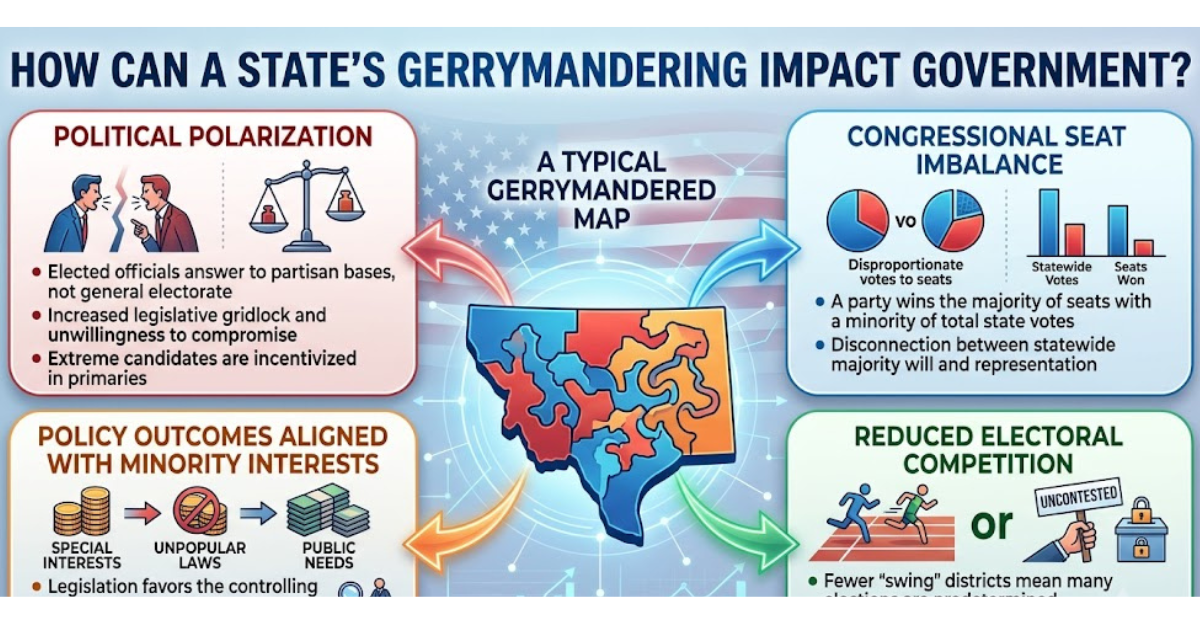
If a state draws district boundaries to favor one party, that party may win more congressional seats than its statewide vote share would normally justify.
For example:
- Party A receives 52% of statewide votes.
- Through favorable district maps, Party A wins 70% of congressional seats.
This creates a mismatch between voter preferences and actual representation.
Small State Changes Can Have Large National Effects
A few extra seats gained through gerrymandering in multiple states can significantly affect control of Congress.
Even a difference of:
- 5 seats
- 10 seats
- 15 seats
can determine which party holds the majority in the House.
Influence on National Legislation
Controlling the House Means Controlling the Agenda
When a party gains additional congressional seats through favorable district maps, it may gain control of the House of Representatives.
This control affects:
- Which bills are introduced
- Committee leadership positions
- Budget negotiations
- Legislative priorities
As a result, state-level redistricting decisions can influence national laws affecting millions of Americans.
Policy Areas Potentially Affected
Gerrymandering can indirectly impact legislation involving:
- Healthcare
- Taxes
- Education
- Immigration
- Energy policy
- National security
- Infrastructure spending
The composition of Congress determines which policies move forward and which do not.
Impact on Political Party Power Nationwide
Creating Long-Term Electoral Advantages
One of the most significant consequences of gerrymandering is its ability to create durable political advantages.
Districts are often used for an entire decade between census cycles.
This means a party may benefit from favorable maps for years, even if public opinion shifts.
Reduced Electoral Competition
Many gerrymandered districts become “safe seats.”
In these districts:
- One party consistently wins.
- General elections become less competitive.
- Candidates focus more on primary elections.
This can reduce accountability and voter influence.
How Gerrymandering Can Affect Presidential Politics
Although presidential elections are determined differently, gerrymandering can still have indirect effects.
Building Political Infrastructure
Members of Congress often:
- Raise campaign funds
- Support presidential candidates
- Mobilize voters
- Shape party messaging
A party with stronger congressional representation can gain advantages during presidential election cycles.
Influencing Electoral Certification and Governance
Congress plays a role in federal election procedures and governance.
The makeup of Congress can influence discussions involving:
- Election laws
- Voting rights legislation
- Electoral reforms
- Federal oversight policies
Thus, district maps created within states may ultimately affect national political processes.
Effects on Voter Representation
When Votes Carry Unequal Influence
A major criticism of gerrymandering is that it can distort voter representation.
In some situations:
- A party wins fewer votes statewide.
- Yet secures more congressional seats.
This raises concerns about whether election outcomes accurately reflect public preferences.
Impact on Public Trust
When voters believe district maps are unfair, trust in democratic institutions may decline.
Potential consequences include:
- Lower voter participation
- Increased political polarization
- Reduced confidence in elections
- Greater public dissatisfaction
Real-World Examples of Gerrymandering Debates
Several states have faced intense debates and legal challenges regarding district maps.
Examples include:
- North Carolina
- Wisconsin
- Texas
- Pennsylvania
- Maryland
- Ohio
These states have experienced court cases, redistricting disputes, and public discussions about fairness and representation.
While each situation differs, they demonstrate how state-level district decisions can influence congressional outcomes nationwide.
The Connection Between Gerrymandering and Political Polarization
Why Safe Districts Matter
In highly competitive districts, candidates often appeal to a broad range of voters.
In heavily gerrymandered districts, candidates may focus primarily on voters within their own party.
This can encourage:
- More partisan positions
- Less compromise
- Increased political division
National Consequences
When many congressional districts become politically one-sided, Congress itself may become more polarized.
This can make it harder to:
- Pass legislation
- Reach bipartisan agreements
- Address national challenges effectively
Efforts to Reduce Gerrymandering
Various approaches have been proposed to create fairer district maps.
Independent Redistricting Commissions
Some states use independent commissions rather than lawmakers to draw district boundaries.
Supporters argue that this can reduce political bias.
Judicial Review
Courts sometimes review district maps for potential constitutional or legal violations.
Mapping Transparency
Advocates often recommend:
- Public hearings
- Open mapping data
- Citizen participation
- Clear redistricting standards
Greater transparency can increase public confidence in the process.
Key Takeaways
- Gerrymandering involves drawing electoral districts to benefit specific political interests.
- Congressional districts are created by states, but their effects can reach the federal government.
- State gerrymandering can influence the balance of power in the U.S. House of Representatives.
- Congressional control affects national legislation, budgets, and policy priorities.
- Gerrymandering may contribute to political polarization and reduced electoral competition.
- Fair redistricting practices can help improve representation and public trust.
Frequently Asked Questions (FAQs)
1. How can a state’s gerrymandering impact government at the national level?
A state’s gerrymandering can influence which candidates win congressional seats. Since Congress creates federal laws, district maps can affect national policymaking and political power.
2. Does gerrymandering affect presidential elections?
Not directly, because presidential elections are based on statewide voting in most states. However, gerrymandering can shape congressional representation and party strength, which indirectly affects national politics.
3. Why is gerrymandering controversial?
Critics argue that it can distort representation by allowing political parties to win more seats than their share of votes would normally justify. This may reduce electoral fairness and voter influence.
4. Which branch of government is most affected by gerrymandering?
The legislative branch, particularly the U.S. House of Representatives, is most directly affected because House members are elected from congressional districts.
5. Can courts stop gerrymandering?
Courts can review district maps and sometimes require changes if they violate constitutional principles or voting rights protections. The extent of court involvement varies by case.
6. What is the difference between redistricting and gerrymandering?
Redistricting is the routine process of redrawing district boundaries after a census. Gerrymandering occurs when those boundaries are intentionally manipulated for political advantage.
Conclusion
Understanding how can a state’s gerrymandering impact government at the national level reveals just how interconnected state and federal politics truly are. Although district maps are drawn within individual states, their effects can shape congressional representation, influence national legislation, alter political power balances, and affect the overall functioning of American democracy.
As debates over electoral fairness continue, understanding the role of gerrymandering helps voters make informed decisions and engage more effectively in the democratic process. Staying informed about redistricting and representation is an important step toward understanding how government works at every level.