








Managing household expenses can sometimes feel like trying to hit a moving target. One month your electricity bill is manageable, and the next it’s surprisingly high because of extreme weather or seasonal energy use. These unpredictable costs can make budgeting difficult.
If you’ve ever wondered what is equal billing and how can it help you when creating your monthly budget?, you’re not alone. Equal billing is designed to make monthly utility expenses more predictable, helping households avoid financial surprises. In this guide, you’ll learn how equal billing works, its advantages and disadvantages, who should consider it, and practical ways to make it part of a smarter financial plan.
Understanding Equal Billing
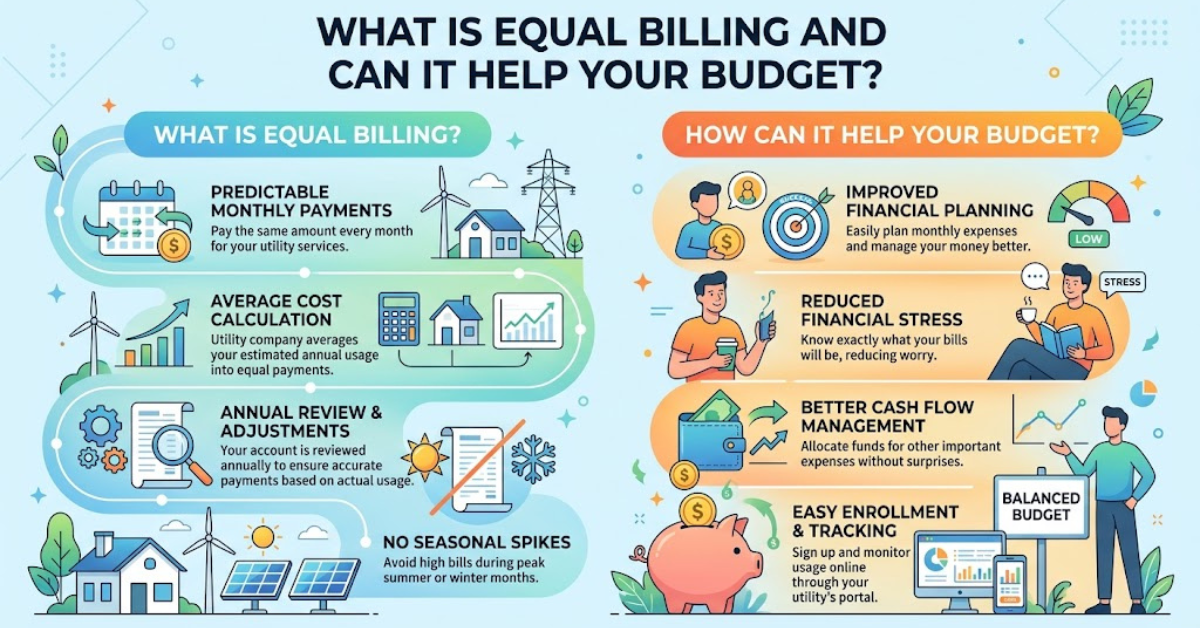
Equal billing, often called budget billing, levelized billing, or balanced billing, is a payment option offered by many utility companies. Instead of paying the exact amount you owe each month based on current usage, your provider calculates an average monthly payment based on your historical energy consumption.
This means you’ll generally pay the same amount each month, even if your actual energy use changes throughout the year.
For example:
- January utility bill based on usage: $220
- April utility bill based on usage: $95
- July utility bill based on usage: $260
Instead of paying these varying amounts, your provider may average your annual costs and charge approximately $170 every month.
This consistency makes financial planning much easier.
How Does Equal Billing Work?
Although each utility provider has its own policies, the process usually follows similar steps.
Step 1: Review Past Usage
The utility company reviews your previous 12 months of energy consumption.
If you’re a new customer, they may estimate your usage based on:
- Previous occupants
- Similar homes nearby
- Estimated household size
Step 2: Calculate the Average
The company totals your annual energy costs and divides them into equal monthly payments.
For example:
- Annual energy costs: $2,400
- Monthly equal billing amount: $200
Step 3: Periodic Adjustments
Because energy prices and usage can change, providers periodically review your account.
If you’ve used significantly more or less energy than expected, they may:
- Increase your monthly payment
- Lower your monthly payment
- Apply a credit
- Charge a balance adjustment
This adjustment often happens every 6 to 12 months.
Why Utility Bills Fluctuate Throughout the Year
Understanding why bills change helps explain why equal billing is useful.
Several factors influence utility costs:
- Hot summers increase air conditioning use.
- Cold winters increase heating costs.
- Utility rates may rise.
- Family size may change.
- New appliances affect electricity consumption.
- Weather conditions influence energy demand.
Without equal billing, these factors can create unpredictable monthly expenses.
What Is Equal Billing and How Can It Help You When Creating Your Monthly Budget?
The biggest advantage is predictability.
Instead of guessing how much you’ll owe each month, you know your utility payment in advance.
This makes it easier to:
- Plan monthly expenses
- Reduce financial stress
- Avoid seasonal bill spikes
- Improve cash flow
- Stick to savings goals
- Prevent overspending
Imagine creating this monthly budget:
| Expense | Monthly Cost |
| Rent | $1,200 |
| Groceries | $450 |
| Internet | $70 |
| Car Payment | $300 |
| Utility (Equal Billing) | $180 |
| Insurance | $140 |
Because your utility payment stays relatively consistent, budgeting becomes much simpler.
Benefits of Equal Billing
Easier Budget Planning
Predictable expenses are easier to manage.
When your bills remain steady, it’s simpler to determine:
- How much you can save
- How much you can invest
- How much discretionary spending you can afford
Reduces Seasonal Financial Stress
Winter heating bills and summer cooling bills often surprise homeowners.
Equal billing spreads those costs across the year instead of concentrating them into expensive months.
Better Cash Flow Management
Stable monthly expenses help households avoid cash shortages.
This is especially valuable for people with:
- Fixed incomes
- Retirement income
- Hourly wages
- Freelance income
- Seasonal employment
Encourages Better Financial Discipline
Knowing your monthly obligations makes it easier to:
- Pay bills on time
- Avoid late fees
- Build emergency savings
- Maintain consistent spending habits
Fewer Budget Surprises
Unexpected bills can disrupt financial goals.
Equal billing minimizes these surprises by creating more consistent monthly payments.
Potential Drawbacks of Equal Billing
Although equal billing offers many advantages, it isn’t perfect.
Annual Adjustments
If your actual usage exceeds estimates, your payment may increase during the annual review.
Some customers receive a catch-up bill.
Doesn’t Reduce Energy Consumption
Equal billing changes when you pay—not how much energy you use.
If you waste electricity, you’ll eventually pay for that increased usage.
Rising Utility Rates
If utility companies raise prices during the year, your equal billing amount may also increase after review.
False Sense of Savings
Some customers mistakenly believe equal billing lowers their costs.
In reality, it simply spreads payments more evenly over time.
Who Should Consider Equal Billing?
Equal billing works particularly well for:
Homeowners
Families with predictable annual utility usage often benefit the most.
Renters
Many renters can enroll if utilities are in their name.
Retirees
People living on fixed monthly income appreciate consistent expenses.
Families
Households with children often experience high seasonal utility use.
Equal billing helps smooth those fluctuations.
First-Time Budgeters
If you’re learning to manage money, consistent bills make budgeting much easier.
Who May Not Benefit?
Equal billing may be less useful if you:
- Frequently move
- Have highly unpredictable occupancy
- Recently installed major appliances
- Plan significant home renovations
- Prefer paying actual monthly usage
Equal Billing vs. Paying Actual Monthly Usage
| Equal Billing | Actual Billing |
| Predictable monthly payments | Monthly costs vary |
| Easier budgeting | Bills fluctuate seasonally |
| Less financial stress | Possible bill surprises |
| Periodic adjustments | No balancing adjustments |
| Better cash flow planning | Reflects exact monthly usage |
Tips for Making Equal Billing Work Better
Equal billing is most effective when combined with smart budgeting habits.
Monitor Your Energy Usage
Continue checking monthly statements.
Even though payments stay similar, your actual consumption still matters.
Build an Emergency Fund
Annual adjustments occasionally increase payments.
Having emergency savings helps cover unexpected differences.
Improve Energy Efficiency
Lower annual energy use by:
- Installing LED bulbs
- Using programmable thermostats
- Sealing windows
- Upgrading insulation
- Maintaining HVAC systems
- Unplugging unused electronics
Lower usage can eventually reduce your equal billing amount.
Review Your Utility Statement
Most providers include:
- Actual energy used
- Equal billing payment
- Current account balance
- Estimated annual adjustment
Understanding these details helps prevent surprises.
Common Myths About Equal Billing
Myth 1: Equal Billing Costs More
False.
It doesn’t increase your annual costs—it simply spreads payments evenly.
Myth 2: You Never Pay Extra
Not necessarily.
If your actual energy use exceeds estimates, adjustments may occur.
Myth 3: Everyone Qualifies
Some providers require:
- Good payment history
- Minimum account age
- No overdue balances
Eligibility varies.
Myth 4: Equal Billing Eliminates High Bills Forever
It reduces monthly fluctuations but doesn’t eliminate overall energy costs.
Real-World Example
Sarah owns a small home.
Without equal billing:
- January: $245
- February: $230
- March: $170
- April: $115
- May: $95
- June: $180
- July: $285
- August: $275
Planning monthly finances became difficult.
After enrolling in equal billing, her provider averaged annual costs at $190 per month.
Now Sarah can:
- Budget more confidently
- Save consistently
- Avoid seasonal payment shocks
- Focus on long-term financial goals
Practical Tips Before Signing Up
Before enrolling:
- Ask how often adjustments occur.
- Understand how balances are calculated.
- Review cancellation policies.
- Check eligibility requirements.
- Continue monitoring energy usage.
- Read monthly statements carefully.
Key Takeaways
- Equal billing averages utility payments across the year.
- It improves monthly budget predictability.
- Seasonal bill spikes become easier to manage.
- It doesn’t reduce total energy costs.
- Annual adjustments may increase or decrease future payments.
- Combining equal billing with energy-efficient habits delivers the best results.
Frequently Asked Questions
What is equal billing and how can it help you when creating your monthly budget?
Equal billing averages your annual utility costs into consistent monthly payments. This predictability makes budgeting easier by reducing seasonal fluctuations and helping you plan expenses more effectively.
Is equal billing the same as budget billing?
Yes. Many utility companies use terms such as budget billing, balanced billing, or levelized billing interchangeably. The basic concept is the same: spreading estimated annual utility costs evenly across monthly payments.
Does equal billing save money?
Equal billing doesn’t lower your total utility expenses. Instead, it spreads costs more evenly throughout the year, making them easier to manage.
Can my equal billing payment change?
Yes. Most providers review your account periodically and adjust your monthly payment if your actual energy usage differs significantly from estimates or if utility rates change.
Is equal billing a good choice for homeowners?
For many homeowners, equal billing simplifies financial planning by replacing unpredictable utility bills with consistent monthly payments. It’s especially useful for households with seasonal heating or cooling costs.
Can renters use equal billing?
Many renters can enroll if they have utility accounts in their own name and meet the provider’s eligibility requirements. Check with your utility company to confirm availability.
Conclusion
Understanding what is equal billing and how can it help you when creating your monthly budget? can make a significant difference in how you manage household finances. Rather than facing unpredictable utility bills throughout the year, equal billing gives you consistent monthly payments that simplify planning, reduce stress, and support better financial habits.
While it doesn’t lower your total energy costs, it can make budgeting more accurate and manageable. If your utility provider offers an equal billing program, review the terms carefully and consider whether it aligns with your financial goals. Combined with mindful energy use and a well-planned budget, equal billing can be a practical tool for achieving greater financial stability and peace of mind.